At the Grand Finale of the 7th School Sanitation Solutions Challenge, the head of Ghanaian reusable pad brand EcoPeriod showed the government how the same GHS 292.4 million could keep two million schoolgirls supplied for three years instead of one.
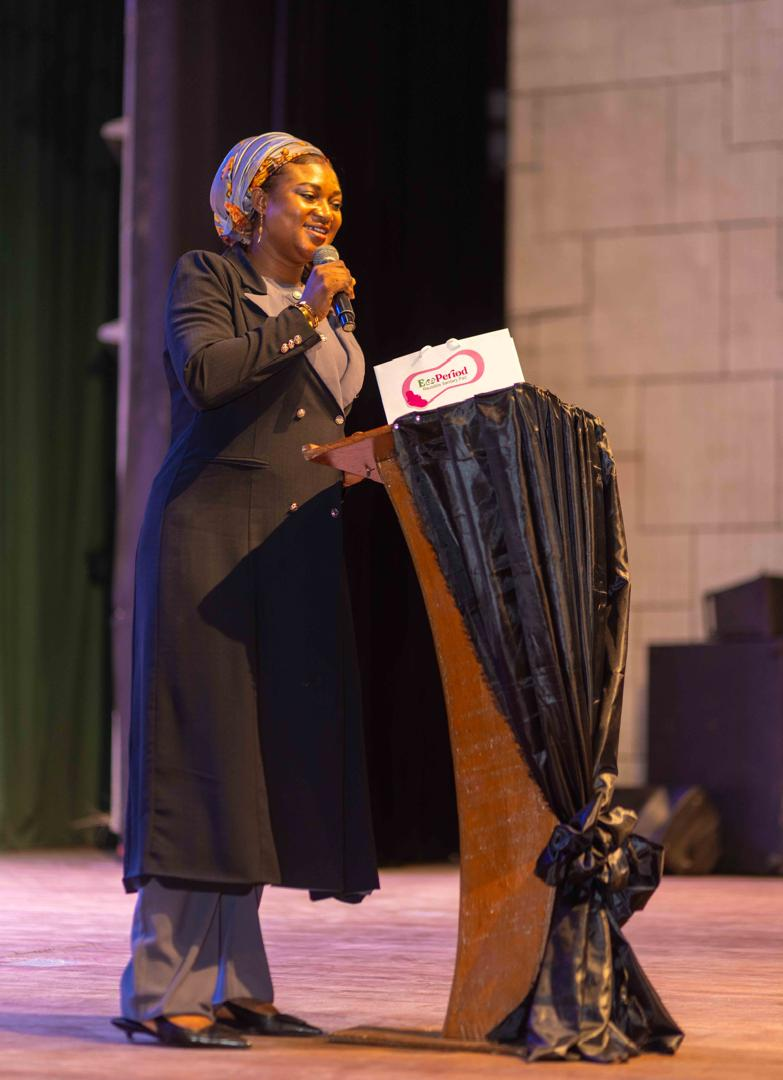
Sanitation does not end at the toilet door. That was the message Amdiya Abdul Latiff, Founder and CEO of Eco-Me Africa, the maker of EcoPeriod reusable sanitary pads, brought to government ministers, development partners and schoolchildren from across the country at the National Theatre in Accra.
Speaking at the 5th Children Sanitation Festival and Grand Finale of the 7th School Sanitation Solutions (Triple S) Challenge, organised by World Vision Ghana with the Ministry of Local Government, Chieftaincy and Religious Affairs, the Ghana Education Service, Zoomlion Foundation and other partners, she turned the room’s attention to a part of sanitation that rarely makes the agenda.
“I want to talk about a part of sanitation we don’t always say out loud: the girl child’s period,” she said.
A plastic problem the size of a landfill
Abdul Latiff opened with the environmental cost of disposable menstrual products. Over 45 billion are used worldwide every year, she said, about 90 percent of them plastic. A single woman can use up to 11,000 disposable pads in her lifetime, and each can take up to 800 years to break down.
Citing UNICEF Ghana and the Environmental Protection Agency, she told the audience that if every menstruating woman in Ghana used just one disposable pad a day, more than 100 million pads would reach the country’s landfills every month.
Behind that waste, she argued, sits period poverty. More than 500 million women and girls worldwide cannot afford or access menstrual products, and in Ghana, she said, 95 percent of girls sometimes miss school because of their period. “A silent barrier, wrapped in shame and silence,” she called it, adding that both crises feed a third: the unemployment that keeps communities poor.
Chemical-free, reusable and made in Ghana
Eco-Me Africa was built to tackle all three at once. The company manufactures EcoPeriod pads locally, trains and employs socially disadvantaged women to produce them, and distributes every pad alongside menstrual and reproductive health education.
Holding up a pad for the audience, Abdul Latiff described the product: made from soft, absorbent, sustainable materials and free from the synthetic gels and chemicals found in ordinary disposable pads, which lowers the risk of allergies, infection and discomfort. It washes easily and dries fast.
“Every girl and woman can manage her period with comfort, dignity and confidence,” she said.

Three asks for Ghana’s Free Sanitary Pad Policy
Abdul Latiff then addressed the government directly, setting out three requests.
The first concerned value for money. This year’s GHS 292.4 million budget for the Free Sanitary Pad Policy buys disposable pads for two million girls for one year, and must be spent again every year after. Spent on EcoPeriod at GHS 80 per kit, with each kit lasting at least three years, the same budget would cover those two million girls for three years and still leave GHS 132.4 million to begin closing the toilet and changing-room gap the same girls face in school.
“No monthly restocking, no burning pads for disposal, no allergies from synthetic gels,” she said. “Include certified, local, reusable pads in that policy.”
Her second request was for faster regulatory approval. “President Mahama has already directed local sourcing for this policy,” she said. “Fast-track our FDA registration, so a Ghanaian-certified solution isn’t left waiting for a policy it was built to serve.”
The third was an invitation to test the model: a costed government pilot with Eco-Me Africa in the communities with the greatest need. “Let the results make the case,” she said.
Partnering with World Vision Ghana
Eco-Me Africa was an official sponsor of this year’s festival, joining World Vision Ghana’s push to make young people sanitation ambassadors in their schools and communities. The Triple S Challenge gives schoolchildren a platform to design practical solutions to sanitation problems, with the 2026 edition focused on behaviour change among peers, families and communities.
In his welcome message, World Vision Ghana’s Interim National Director, Joshua Baidoo, noted that many school toilets have no changing rooms for girls, leaving schools unfriendly to the girl child. EcoPeriod’s partnership with World Vision Ghana brings menstrual health squarely into that conversation, linking dignity for girls, healthier schools and less waste.
Abdul Latiff closed with a call to every partner in the room, from government and development agencies to the private sector. “Sanitation conscience cannot stop at the toilet door,” she said. “It must follow a girl through every single day of her month. That is the work Eco-Me Africa has committed to, and we invite every partner in this room to join us in finishing it.”
About EcoPeriod and Eco-Me Africa
Eco-Me Africa is a Ghana-based social enterprise and the producer of EcoPeriod, high-quality, chemical-free reusable sanitary pads certified by the Ghana Standards Authority. Founded by award-winning social entrepreneur and 2023 Mandela Washington Fellow Amdiya Abdul Latiff, the company tackles period poverty, menstrual waste and unemployment by producing pads locally, employing disadvantaged women and delivering menstrual health education. EcoPeriod partners with World Vision Ghana, the Ministry of Education and corporate partners. Learn more at ecoperiodafrica.com