
By Suraya Dadoo
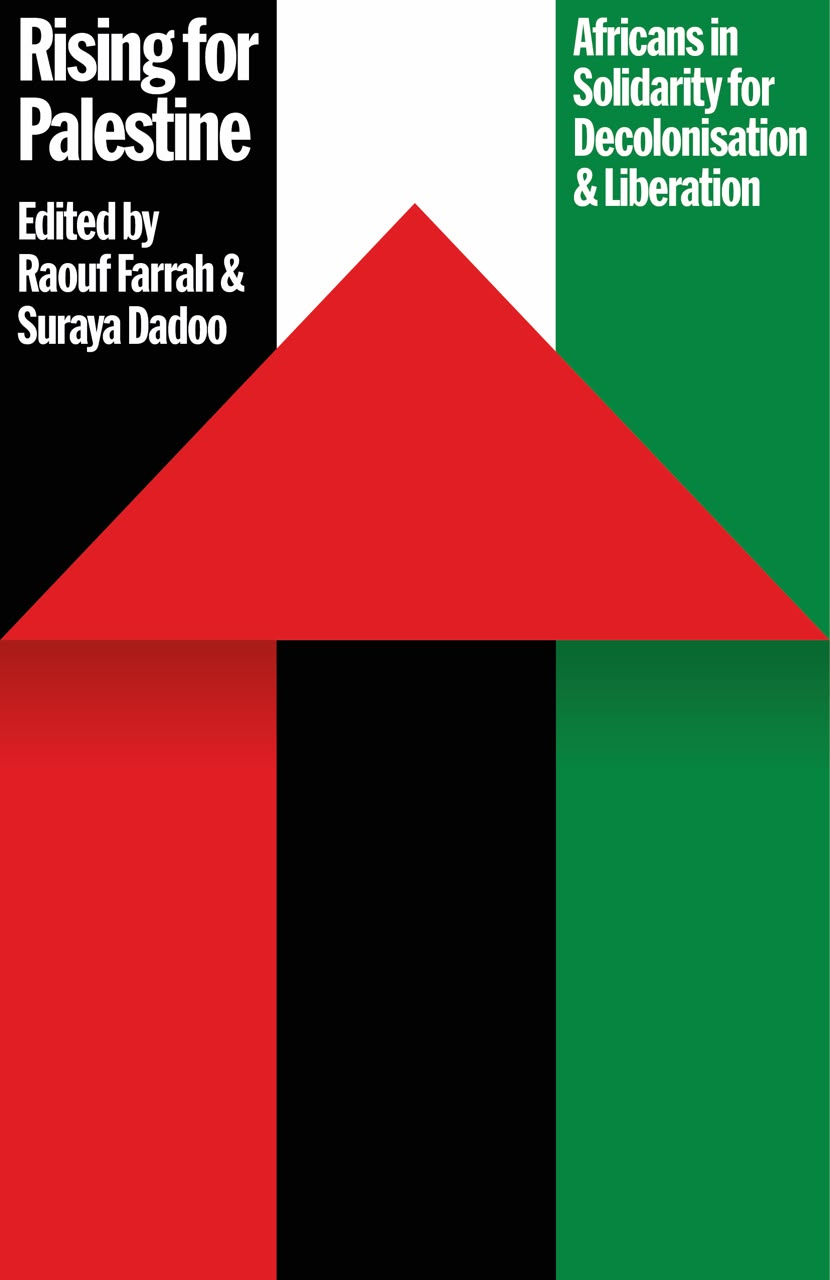
This week, a ground-breaking book is being launched in Accra.
In Rising for Palestine: Africans in Solidarity for Decolonisation and Liberation (Pluto/Militant Publications, 2026), contributors from Western Sahara, Sudan, the DRC, Namibia, Algeria, Kenya, Uganda, and South Africa come together with Palestinians from resistance movements, civil society and political groups.
Together, they explore, for the first time, their shared histories of genocide, apartheid, colonialism and resistance in Palestine and across Africa, with particular attention to the ongoing genocide in Gaza, its direct resonances with present-day Western Sahara, Sudan, and the DRC, and past liberation struggles in Namibia, Kenya, Algeria, and beyond.
“What about Africa?”
Some might ask why there is so much focus on Palestine when there are major crises in Sudan and the DRC.
This question is flawed. It assumes that solidarity is a finite resource, and that attention to Palestine distracts from Africa’s own struggles. This book rejects that logic unequivocally.

Africans don’t need to choose between confronting local injustice and standing with global struggles, as if they are unrelated. In reality, they are profoundly intertwined. Israeli apartheid is part of a global system of racial capitalism, militarised repression, and colonial dispossession that is replicated across the African continent.
To ask, ‘What about Africa?’ is to misunderstand the structure that oppresses both Africa and Palestine. The same powers that arm and shield Israel are the same ones that finance the extractive economies and authoritarian systems that weaken African sovereignty.
This question is also deceitful. It does not arise from a genuine concern for African peoples. It is a tactic to disarm solidarity, contain political consciousness, and enforce silence. The very actors who urge Africans to ‘focus on their own problems’ are often those complicit in causing them.
To stand with Palestine is not to turn away from Congo, Sudan, or Western Sahara; it is to understand that these are not separate fronts, but interconnected sites of struggle.
Memory and duty
This is a book about memory and duty. It remembers Namibia’s genocide in Jephta Uaravaera Nguherimo’s devastating personal reflection of the genocide of his family, tracing generational wounds inflicted by occupation and racialised violence.
It remembers that Congo’s dead number over six million since 1996, perishing in resource-driven warfare under the shadow of multinational corporations and geopolitical power struggles. Congolese activist, Kambale Musavuli, excavates the links between the Congo and Palestine, exposing how Israeli resource interests and authoritarian alliances sustain genocide and ecocide.
It remembers that Western Sahara remains Africa’s last colony. As Saharawi Ambassador Malanin Lakhal underscores, for over three decades the United Nations has failed to organise the promised referendum on self-determination – mandated, yet perpetually deferred.
It remembers that in Sudan, a brutal civil war between the Sudanese Armed Forces and the Rapid Support Forces has devastated and displaced millions, and led to widespread massacres, sexual violence, and famine-like conditions, sustained by foreign powers supplying arms, funding, and political cover.

But to remember any of these is to remember Palestine.
Each struggle is not separate. Palestine is not a singular catastrophe, but a concentrated expression of a mucholder architecture – one that Africa knows with brutal intimacy.
Long before the term ‘genocide’ was ever codified in law, African peoples had already endured its full spectrum of violence. The silence that shrouds Palestine today reverberates with thesilences that accompanied the mass exterminations in Namibia under German colonialism, in the Congo under Belgiandomination, in Rwanda during the genocide, and in Algeria under French rule. Each of these mass crimeswas either enabled or deliberately ignored by the same international actorswho now fuel the Palestinian genocide.
In Palestine and Africa, language sustains oppression. The narratives used to justify this violence are equally familiar: ‘civilisation’, ‘order’, ‘terror’, and ‘self-defence’. These are the same tropes once used to criminalise African liberation movements. Like the Mau Mau in Kenya; the PAIGC (Partido Africano da Independência da Guiné e Cabo Verde) in Guinea-Bissau and Cape Verde; the FLN (Front de libération nationale) in Algeria; and the ANC (African National Congress) in apartheid South Africa. Palestinian resistance, too, is framed not as a struggle for freedom, but as a threat – a force to be contained rather than a people to be liberated.
What connects Palestine to Africa is a shared present shaped by borders drawn to divide, militaries trained to suppress, and lives treated as expendable.
To view Palestine through an African lens is not to appropriate suffering, but to clarify its coordinates.
It is to name the global system that renders both Palestinian and African futures disposable, and that grants impunity to those who bomb with Western weapons and shield atrocities with diplomatic power.
It is to insist that Palestine is not peripheral to African struggle – but central to our unfinished business of decolonisation and liberation. This book is not a detour from Africa’s urgent tasks – it is a contribution to their fulfilment.
To remember Africa’s struggles is to remember Palestine.
Rising for Palestine: Africans in Solidarity for Decolonisation and Liberation is edited by Raouf Farrah and Suraya Dadoo. The book is being launched on Thursday 26 November at 5pm at the UniMAC Auditorium, South Legon.