By Makiza Micheline Latifa
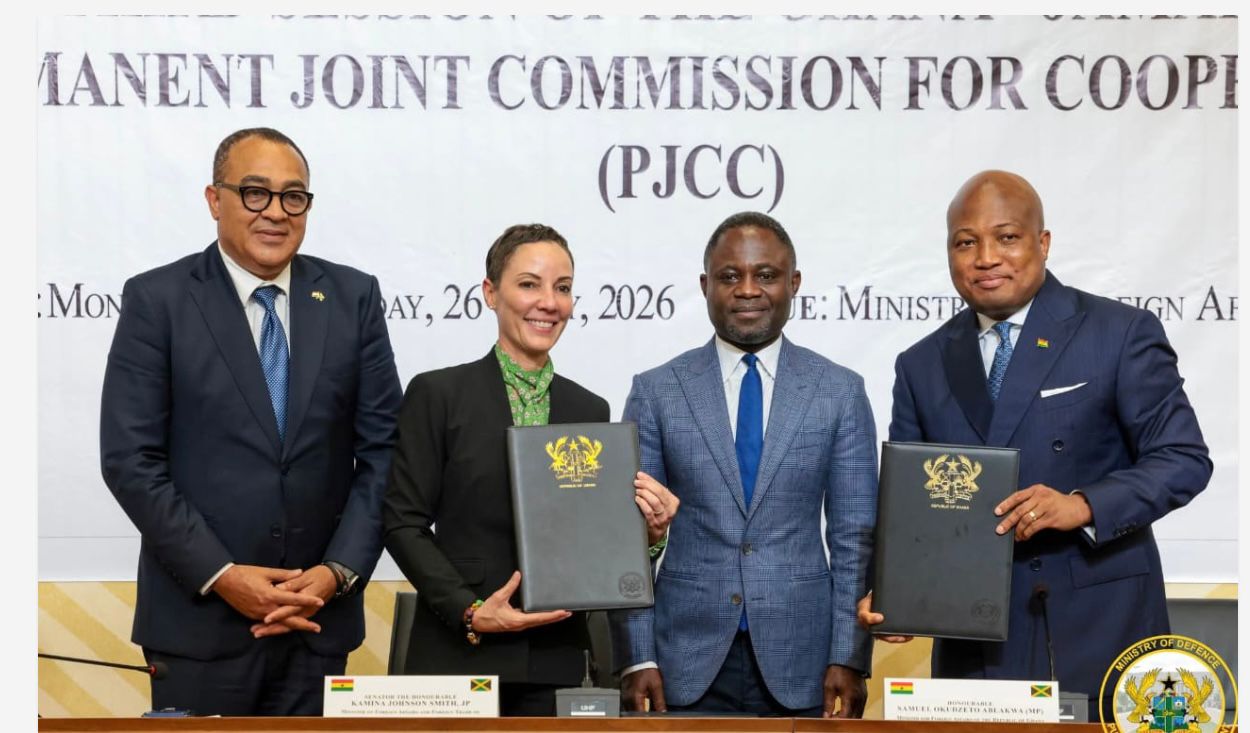
Ghana and Jamaica have pledged to move their decades-long relationship from one of symbolic solidarity to one of practical, measurable outcomes, as the two nations convened the Third Session of the Permanent Joint Commission for Cooperation in Accra.
The session, held after a twenty-one year gap since the last meeting in Kingston in 2005, brought together ministers, diplomats, technical experts and senior government officials from both countries to review existing partnerships and explore new areas of collaboration.
At the heart of the gathering was a relationship forged not through conventional diplomacy, but through shared history. Ghana’s Foreign Affairs Minister Samuel Okudzeto Ablakwa anchored his address in that history, tracing the bond between Accra and Kingston to the transatlantic slave trade and to the pan-Africanist philosophies of Marcus Garvey and Kwame Nkrumah. He described the Commission as a reflection of both nations’ desire to deepen bilateral ties and strengthen cooperation built on mutual respect.
That solidarity has found expression in recent years. Minister Ablakwa acknowledged Jamaica’s support for Ghana’s landmark United Nations Resolution A/RES/80/250, adopted in March 2026, which declared the transatlantic slave trade the gravest crime against humanity. He also pointed to the deployment of Ghana’s Armed Forces Engineers’ Regiment to Kingston following the devastation of Hurricane Melissa as a demonstration of the tangible nature of that friendship.

But the Minister was emphatic that sentiment alone was not enough. He called on both sides to ensure that every objective of the existing Memorandum of Understanding is achieved, and that implementation plans are backed by concrete, time-bound action. He identified health, agriculture, education, climate resilience, technology transfer, tourism and human capital development as priority areas for deeper collaboration.
Two deliverables dominated the conversation on the Ghanaian side. The first: a direct flight between Accra and Kingston. Minister Ablakwa disclosed that President John Dramani Mahama has directed the technical committee overseeing the revival of Ghana Airways to prioritise a direct Ghana-Caribbean route once the national airline resumes operations. The second: full physical diplomatic presence in both countries. Minister Ablakwa confirmed that Ghana is committed to opening a High Commission in Jamaica, and expressed his expectation that Jamaica would reciprocate by establishing a diplomatic mission in Accra, a step he said would enhance political, economic and cultural ties between the two nations.
On the Jamaican side, Senator Kamina Johnson Smith, Jamaica’s Minister of Foreign Affairs and Foreign Trade and the country’s first female to hold that office, struck a tone of renewed purpose. She described the session as representing a new era in implementing the shared philosophies that have long defined the relationship, saying the bond between Jamaica and Ghana, rooted in shared struggles and shared victories, remained unshakable.
The session produced several concrete outcomes. A bilateral health workforce mobility agreement was signed, establishing a formal framework for the deployment of Ghanaian health professionals to Jamaica, an arrangement Senator Johnson Smith said would strengthen healthcare delivery in Jamaica while creating employment and professional development opportunities for Ghanaian workers. The first cohort of Ghanaian nurses and health professionals is expected to depart for Jamaica in June 2026, subject to the completion of final administrative processes.
Minister Ablakwa also indicated that a bilateral agreement in education, focused on the deployment of Ghanaian teachers to Jamaica, is expected to be finalised during an anticipated state visit by President Mahama to Jamaica at the invitation of Prime Minister Andrew Holness.
The agreements signed during the session cover health, defence, arts and culture, and officials on both sides say they signal a shift in how the two nations intend to relate going forward: less ceremonial, more consequential.
Ghana is also set to host a High-Level Consultative Conference on reparatory justice from June 17 to 19, 2026, and Jamaica’s presence at this week’s PJCC underscored the two countries’ alignment on that broader agenda as well.
For Ghana, the revival of this Commission is part of a wider diplomatic push under the Mahama administration to formalise and deepen ties with African diaspora nations, building partnerships that honour history while delivering for people in the present.