By Makiza Micheline Latifa
ACCRA, November 13, 2026 – Ghana has called on African Union (AU) Member States to urgently implement the agreed 0.2 per cent levy on eligible imports as part of efforts to strengthen the continental body’s financial independence and reduce its reliance on external funding.
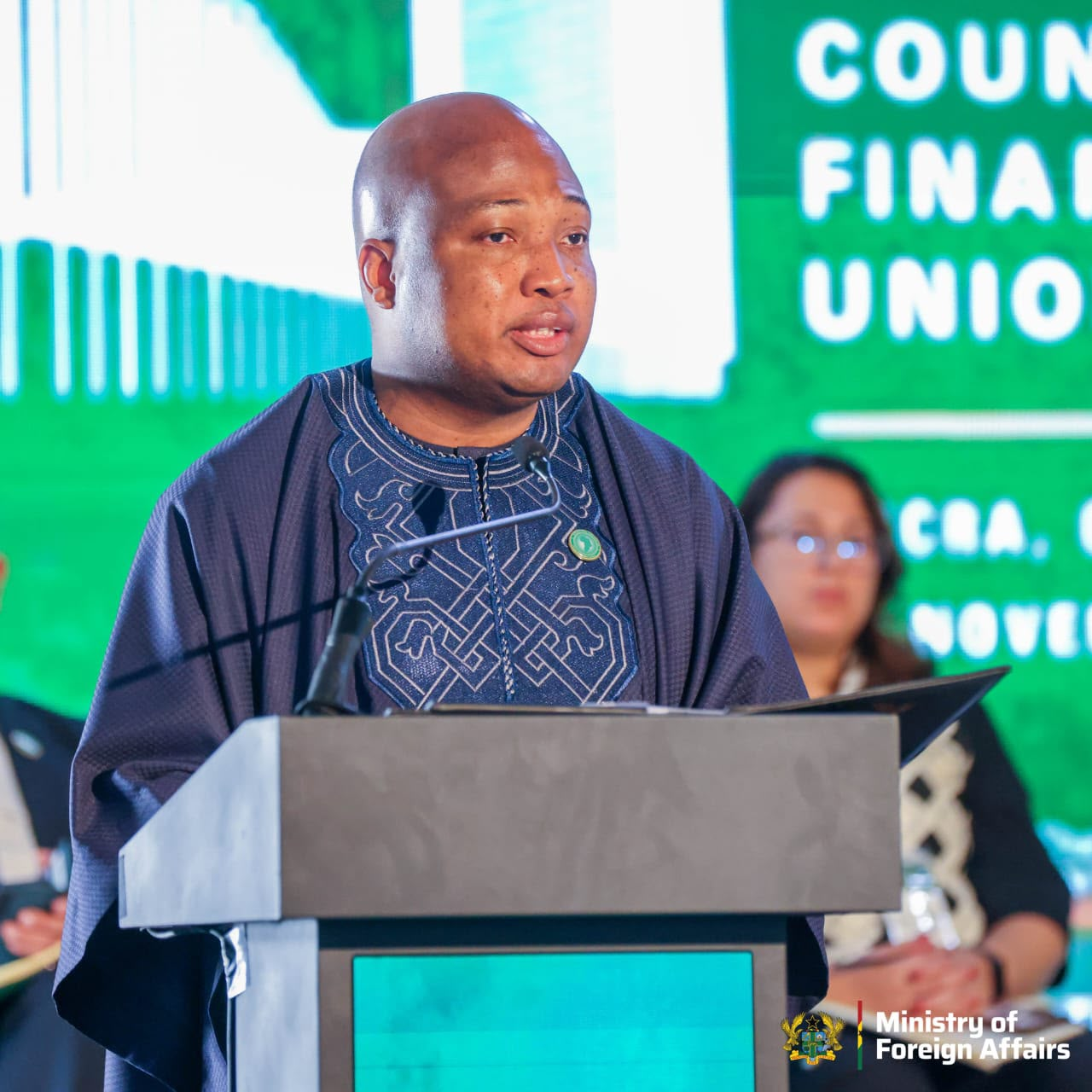
Minister for Foreign Affairs, Samuel Okudzeto Ablakwa, made the call in an address at the opening of the 27th Extraordinary Session of the AU Executive Council, dedicated to Financing the Union, in Accra on Friday.
He said Africa must move beyond commitments to financial autonomy and take concrete steps towards generating the resources needed to fund its own institutions, programmes and peace and security operations.
Mr Ablakwa observed that despite the continent’s commitment to financial self-reliance, implementation of the 2016 Kigali decision on the 0.2 per cent levy remained limited, with only 18 of the AU’s 55 Member States having implemented the mechanism.
He further highlighted the imbalance in the Union’s financing structure, noting that while Member States are projected to cover nearly 99 per cent of the AU’s operational budget in 2027, they currently contribute only about four per cent of its programme budget and approximately 12 per cent of its peace and security budget.
“Put plainly: we pay for the lights, but we ask others to pay for the work,” he stated.
The Foreign Affairs Minister described the situation as a challenge to Africa’s aspirations for institutional independence, arguing that the continent could not continue to depend on external partners to finance priorities determined by Africans themselves.
He called for the adoption of an integrated reform approach, known as Option C, which combines sustainable financing with institutional efficiency.
The proposed approach includes eliminating duplication across AU institutions, rationalising overlapping programmes and adopting a unified programme-based budget supported by a medium-term expenditure framework.
Mr Ablakwa also urged Member States to strengthen the implementation of the AU’s Division of Labour framework, which assigns strategic direction to the continental body, regional implementation to Regional Economic Communities, and ownership and accountability to Member States.
On peace and security, he stressed the need to prioritise conflict prevention, preventive diplomacy, mediation and early-warning systems rather than relying primarily on interventions after crises have escalated.
He reaffirmed Ghana’s support for strengthening the African Union Peace Fund, including increasing its endowment target from 400 million dollars to one billion dollars, alongside a replenishment mechanism and diversified funding sources.
He also called for accelerated implementation of United Nations Security Council Resolution 2719 (2023) to ensure predictable financing for African-led peace support operations.
Beyond Member State contributions, the Minister identified African multilateral financial institutions as a critical source of funding for the continent’s development priorities.
He welcomed the proposed partnership between the AU Commission and the Alliance of African Multilateral Financial Institutions, which seeks to mobilise additional African resources for investment, insurance, guarantees and risk mitigation.
The partnership has set targets to double the capital and financing capacity of participating institutions within three to five years and mobilise an additional 200 billion dollars over the next decade.
Mr Ablakwa emphasised, however, that such partnerships must complement rather than replace the financial obligations of AU Member States.
He further underscored the importance of establishing the African Central Bank, African Monetary Fund and African Investment Bank, describing them as essential pillars of the continent’s financial sovereignty.
In this regard, he announced that Ghana intends to deposit its instruments of ratification for the African Union financial institutions by 2027, while urging other Member States to take concrete steps towards ratification.
He also announced plans for Ghana to host an Extraordinary Summit on African Financial Institutions in Accra in 2027, when the country assumes the Chairmanship of the African Union.
As part of its proposals for the current session, Ghana is advocating an Accra Declaration on Financing the Union, built around six commitments, including the adoption of the integrated financing and reform pathway, implementation of the import levy, budget reforms, strengthening the Peace Fund, institutionalising partnerships with African financial institutions and reviewing Member State contribution arrangements.
The proposed declaration is expected to be supported by a time-bound implementation framework outlining responsibilities, milestones and reporting mechanisms ahead of the 2027 summit.
Mr Ablakwa said the success of the deliberations should ultimately be measured by concrete commitments and their implementation, rather than declarations alone.
Quoting Ghana’s first President, Kwame Nkrumah, on the inseparability of Ghana’s independence from the liberation of Africa, he argued that the African Union’s financial independence must similarly translate into the empowerment of African people.
The 27th Extraordinary Session of the AU Executive Council brings together Ministers of Foreign Affairs and Finance from Member States, AU Commission leadership and representatives of continental institutions to consider measures for strengthening the Union’s financial sustainability, institutional effectiveness and capacity to deliver on its priorities.