By Victoria Wilson |
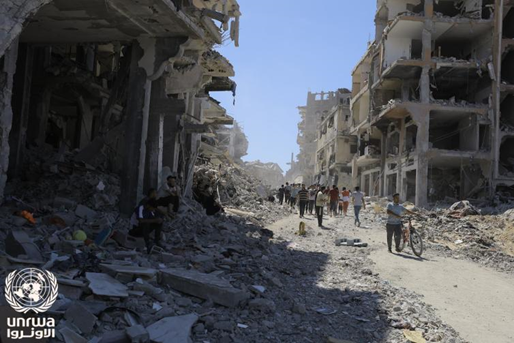
The camp’s police station, struck again in July 2026, stands amid destruction UNRWA has documented across Jabalia since the war’s early months. Photo: Hussein Jaber / UNRWA via Wikimedia Commons (CC BY-SA 3.0 IGO)
An Israeli strike on the police station in Gaza’s Jabalia refugee camp killed the station’s director, Colonel Mohammed Marwan Salem, six other officers, and a woman on 14 July. The Israeli military said four of the dead officers were “Hamas militants,” a claim it did not support with evidence. The strike was the twelfth documented attack on Gaza’s police since January, a pattern that has killed at least 35 officers and that the United Nations Human Rights Office, OHCHR, says meets the legal threshold for war crimes. All of it has occurred since the ceasefire between Israel and Hamas took effect on 10 October 2025.
The ceasefire’s own numbers describe an eight-month period of continuous violation rather than a pause. Gaza’s Government Media Office has documented 3,689 recorded breaches over 275 days, resulting in the deaths of 1,123 Palestinians by 15 July, more than 260 of them children. Ten-year-old Muataz Abu Shaar was shot dead by Israeli gunfire in Rafah’s al-Mawasi area that day; nine-year-old Tala Abu Matar had been killed two days earlier in an attack on the al-Bureij refugee camp that took six lives. The total death toll in Gaza since the war began on 8 October 2023 stands at more than 73,000 Palestinians.
Eight Months, Not a Pause

Netanyahu told an audience at a West Bank settlement on 29 May 2026 that the military’s directive was to take Gaza “step by step… first of all 70 percent.” Photo: Avi Ohayon / Government Press Office of Israel via Wikimedia Commons (CC BY-SA 3.0)
The territory Israeli forces control inside Gaza has not stood still since the ceasefire began. At the “yellow line” agreed in October, Israeli forces held roughly half the Strip. By spring, a new “orange line” put the figure at 60 to 64 percent. On 29 May, Prime Minister Benjamin Netanyahu told an audience at an illegal West Bank settlement that the military’s “directive is to move to… take [Gaza] step by step… first of all 70 percent,” a line that drew calls of “One hundred! One hundred!” from the crowd. Defense Minister Israel Katz has separately referred to plans for “voluntary emigration from Gaza,” managed through a “voluntary emigration bureau” the security cabinet established in 2025, a body Truthout has described as facilitating ethnic cleansing.
EU Commissioner Hadja Lahbib, describing the same period, said Gaza’s “humanitarian space is further shrinking” as boundaries continue to move and aid operations are disrupted. Aid entering Gaza remains roughly 85 percent below the volume the ceasefire agreement specified. As of early June, OHCHR recorded 1.9 million of Gaza’s 2.4 million residents displaced, with at least 1.2 million having lost their housing outright.
Writing in the ceasefire’s second month, Truthout’s Gaza correspondent Dalia Abu Ramadan concluded that “the war has not stopped; it has only changed form: from bombing to quiet expansion, from airstrikes to a creeping occupation.” Colonel Salem, killed at the Jabalia station nine months later, had served as the station’s director.
Who Fills the Vacuum
The 35 police killed since January are not the only civil administrators Israel has targeted. Palestinian Ministry of Education figures put the toll among education personnel at 441 teachers and 117 academics. Analysts describe a pattern that also reaches medical professionals and government officials, arguing its purpose is to prevent Palestinian civil administration from reconstituting itself. “Israeli missiles aim to push the Strip into a cycle of death, non-recovery, chaos and internal security tampering,” wrote Ahmed al-Tanani.
OHCHR has documented the circumstances of individual attacks in the pattern. A 31 January strike on the Ash Sheikh Radwan police station, northwest of Gaza City, killed 11 people, five of them officers, along with inmates and civilians who had come to the station for routine services. A 24 April drone strike hit a police vehicle, killing four officers and four civilians travelling with them. A 23 May strike on a checkpoint in the Al Tawam area of Gaza City killed five officers and two others, including a boy. On each occasion, the personnel killed were performing what OHCHR spokesperson Mayy El Sheikh called functions any occupying power is obligated under international law to allow: “Israel as the occupying power has obligation under international law to ensure civic order… targeting them, unless directly participating in attacks, would amount to war crimes.” OHCHR head Ajith Sunghay put the ceasefire’s practical record in blunter terms in June: “Nearly eight months have passed since ceasefire announcement, and there is no end in sight for killings, turmoil, and misery.”
Analysts describe the pattern as an attempt to derail the post-war governance framework the Trump administration has proposed for Gaza.
An Unevidenced Claim
Asked about the Jabalia deaths, the Israeli military said police stations are “legitimate targets if they’re being used to advance military activities, or if those present are military operatives involved in advancing terrorist activities,” and named four of the dead as Hamas militants. The Associated Press, which reported the claim, noted that the military provided no evidence for it. OHCHR has said of the broader pattern that “the pattern of attacks raises concerns that Israeli forces apply no distinction between police personnel and fighters.” Officers killed in the 23 May and 31 January strikes were staffing checkpoints and serving people who had come to the station for routine matters.
Two Ceasefires
Gaza is not the only place where a ceasefire brokered under Washington’s sponsorship has coincided with continued territorial consolidation by the stronger party. Black Agenda Report has documented the same structure at work eight thousand kilometres away, in the Democratic Republic of Congo’s Kivu provinces. A Qatar-mediated ceasefire in April 2025 and a Washington-brokered “Declaration of Principles” in June, promoted under the language of “sovereignty, security, and economic integration,” have not stopped Rwanda’s proxy militia M23 from displacing Congolese populations and consolidating administrative control over both provincial capitals it seized in January. The Oakland Institute has described the resulting arrangement as one that serves American mining interests while rewarding Rwanda for what the institute calls decades of pillaging Congolese resources. In both cases, the language is sovereignty and partnership; on the ground, territorial and administrative control keeps shifting toward the stronger party. Scholar Muhannad Ayyash, describing the Gaza framework specifically, called it “a battlefield where Israel will continue to try to use it to advance its colonial ambitions.”
Six weeks after the United Nations told Israel that killing Gaza’s civilian police “would amount to war crimes,” those killings have continued at the same pace, and the Jabalia police station has one fewer director than it did before the ceasefire he served under was signed.