By Victoria Wilson
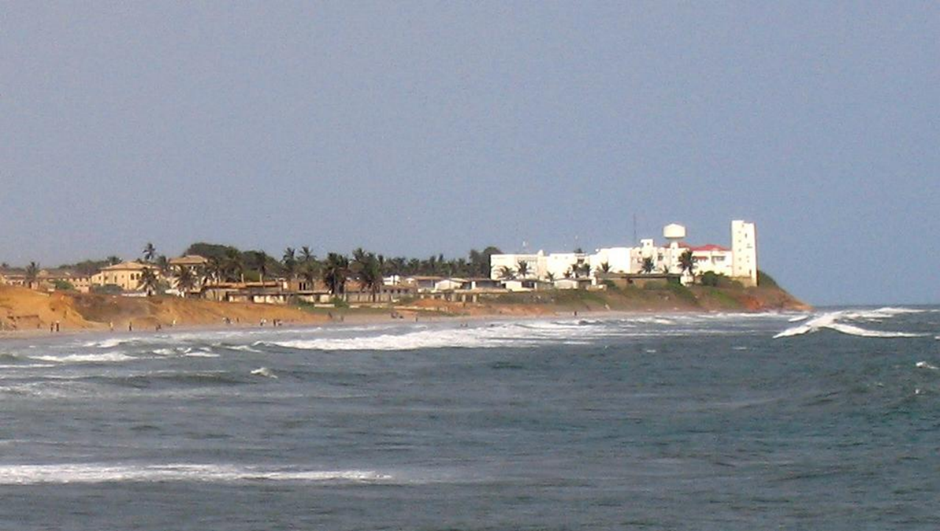
Christiansborg Castle, Osu, Accra, June 19, 2026. Once a processing point for enslaved Africans shipped across the Atlantic, the fortress became the site where the global reparations movement adopted its most comprehensive commitment to repair. Photo: Stig Nygaard / Wikimedia Commons (CC BY 2.0)
On Juneteenth, June 19, 2026, libation ceremonies, wreath-laying and a traditional durbar were held at Christiansborg Castle in Accra as delegates from more than 80 countries formally adopted the Accra Commitment, the reparations movement’s most comprehensive multilateral framework to date. The venue was not chosen without intention: the fortress where enslaved Africans were held before being shipped across the Atlantic became the site of a formal multilateral demand for repair.
Among those present was Dr. Julius Garvey, son of Marcus Mosiah Garvey. Garvey called for a new world order centered on humanity and advocated greater multipolarity in global affairs. His presence at Christiansborg carried a historical resonance difficult to reduce to a single speech.
The Garvey Thread

Delegates at the “Next Steps” High-Level Consultative Conference, Accra, June 17–19, 2026.
Julius Garvey stood at Christiansborg as heads of state, civil society organisations, and diaspora bodies from more than 80 countries adopted the Accra Commitment, a formal demand for apologies, restitution, debt justice, and a global reparations fund. It is the most comprehensive multilateral framework for reparatory justice produced to date. For many delegates present, the event represented a moment of generational continuity, the same political tradition that Marcus Garvey carried into the 20th century was now, in 2026, shaping the terms of a multilateral international framework.
The American Fracture

Delegates at the “Next Steps” conference, Accra, June 2026, representing more than 80 nations. Photo: The Presidency, Republic of Ghana
The United States government voted against Resolution A/RES/80/250 at the United Nations in March 2026. Ambassador Dan Negrea declared that Washington “does not recognize a legal right to reparations for historical wrongs that were not illegal under international law at the time they occurred.” A Pew Research Center survey conducted in 2021 found that only about three in ten US adults supported reparations for descendants of the enslaved in any form.
At Christiansborg on June 19, the United States was represented not by its government but by its civil rights leadership.
Reverend Al Sharpton addressed the ceremony: “Let us honor the memories of those who endured slavery. Let us seek truth to understand, to participate and also to repair. Future generations will judge us not only by what we say but by what we do.” Representatives of the Congressional Black Caucus were equally direct: “History must become action. Remembrance must become repair.”
Those demands pointed beyond Europe, directly at Washington, whose ambassador had declared three months earlier that the US “does not recognize a legal right to reparations for historical wrongs.” The African-American civil society position and the US government’s legal position are in direct contradiction. The diaspora’s most institutionally powerful bloc: the Congressional Black Caucus, was in Accra demanding what its own government had just rejected at the United Nations.
The reparations movement inside the United States has long operated at a distance from US foreign policy. The Accra conference brought that tension into view at the highest level of multilateral engagement it has ever reached, and on a date the diaspora in America marks as its own. Juneteenth at Christiansborg is the moment those two struggles, domestic reparations in the United States and international reparatory justice through the United Nations, were placed on the same international platform.
Ghana’s Architecture of Return

Foreign Affairs Minister Samuel Okudzeto Ablakwa at the conference podium. He described Ghana as “transitioning from being a crime scene to a sanctuary for healing and reparative justice.” Photo: Ghana Ministry of Foreign Affairs
Ghana did not wait for declarations before building the infrastructure of diaspora reconnection. The Year of Return in 2019, marking four hundred years since the first enslaved Africans arrived in the English colonies of North America, brought large numbers of diaspora visitors to Ghana, many of whom have since settled or sought citizenship. According to Ghana’s Ministry of Foreign Affairs, more than 1,000 people have received Ghanaian citizenship through this programme.
Foreign Affairs Minister Samuel Okudzeto Ablakwa described Ghana’s trajectory as “transitioning from being a crime scene to a sanctuary for healing and reparative justice.” His framing positions the reconnection of the diaspora to Africa as itself a form of reparations, already underway through citizenship, land access and right of return, independent of what former colonial powers decide.
The Accra Commitment extends this into international law. Its demand for “full, formal and unconditional apologies as a foundational step towards reconciliation, trust-building and reparatory justice”, and its creation of three permanent international bodies, including an Advisory Council on Reparatory Justice, formalises what Ghana has been building on the ground since 2019. The diaspora arrived at Accra not as guests. The Commitment names it as a rights-bearing constituency within the reparatory justice process.
The Caribbean Charge

Barbados Prime Minister Mia Amor Mottley at the Accra conference. Her statement: “History has gathered us here, but faith has kept us here, and it is duty that will move us forward.”
Barbados Prime Minister Mia Amor Mottley addressed the conference with a challenge that the African continent and the diaspora share: “What does it mean to sing songs of liberation when our peoples across the world have no access to basic necessities of life?”
The question reflects the Caribbean’s particular standing in this debate. The Caribbean Community (CARICOM) Reparations Commission, established in 2013, has developed the most detailed reparations framework in existence, covering financial compensation, psychological rehabilitation, cultural restoration, and debt cancellation. The Caribbean states have spent twelve years defining these demands. The Accra Commitment aligns with the CARICOM framework’s sequencing: formal apologies first, as the “foundational step,” followed by concrete measures. No Caribbean nation voted against the March 2026 resolution.
Mottley answered her own question: “History has gathered us here, but faith has kept us here, and it is duty that will move us forward.” The framing positioned the Caribbean as a political actor with a defined position, not as a petitioner waiting on others.
The Fragmentation Problem

President Mahama presents the Accra Commitment on Reparatory Justice.
President John Dramani Mahama named the structural challenge that has held the movement back for decades: “Our voices were fragmented for decades and it served the interest of some groups to keep those voices fragmented.” Advocates at the conference argued the fragmentation was not accidental and that separate bilateral engagements have historically kept a unified bloc from forming. The pattern has been consistent: African states engaged through development finance, Caribbean nations through debt restructuring, diaspora organisations through symbolic recognition, each addressed separately. The Accra summit brought all three constituencies under a single framework.
The Accra Commitment’s stated priority, “ending fragmentation within the movement by adopting a common blueprint”, is the direct answer to Mahama’s diagnosis. It is also the most unified statement the movement has produced. Whether the coalition, diaspora, Caribbean nations, and continental African states, can hold that unity and convert it into enforceable obligations will be tested at the 82nd Session of the United Nations General Assembly in 2027.