By Victoria Wilson
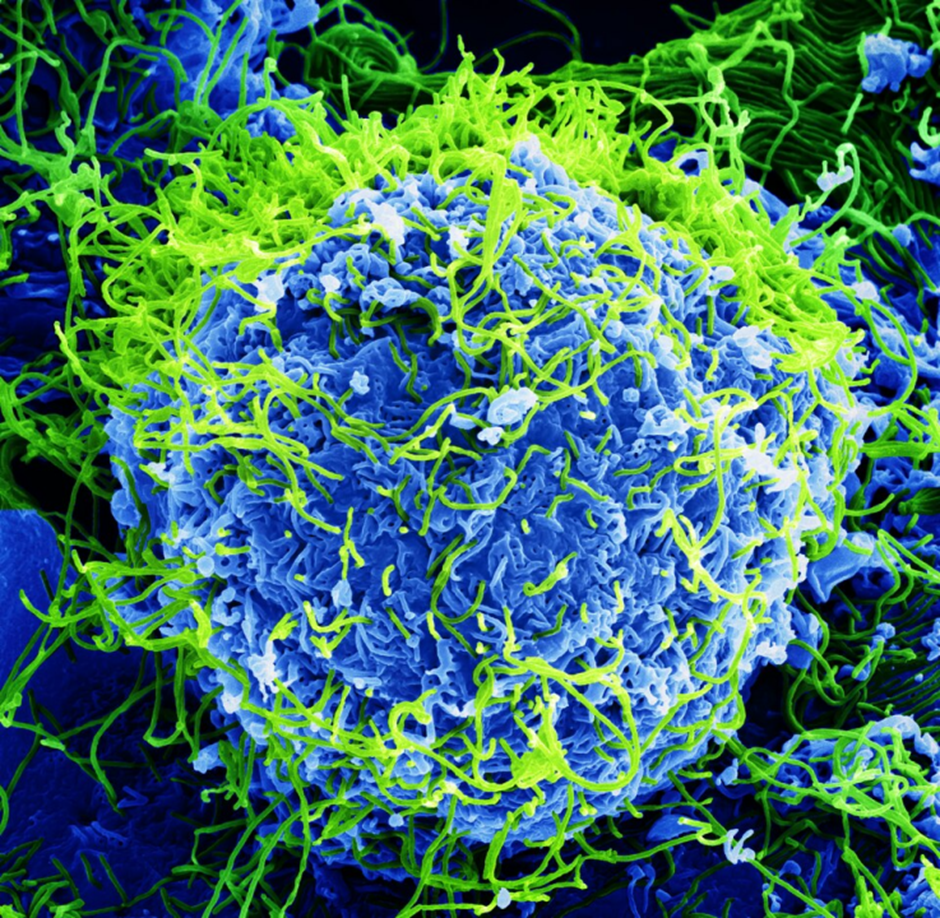
Colorized scanning electron micrograph of Ebola virus particles (green) budding from an infected cell (blue). Photo: BernbaumJG / Wikimedia Commons (CC BY 4.0)
On 21 June 2026, the Ebola outbreak in the Democratic Republic of the Congo crossed 1,003 confirmed cases and 254 deaths. On 22 June, the virus crossed a border: 20 cases and 2 deaths were confirmed in Uganda, the first evidence that the outbreak, concentrated in the northeastern DRC provinces of Ituri, North Kivu, and South Kivu, has begun a regional spread. The World Health Organization declared a Public Health Emergency of International Concern (PHEIC) on 17 May 2026, the highest level of international health alert, and has characterised it as the fastest-rising Ebola outbreak ever recorded. It is the seventeenth outbreak of Ebola in the DRC since 1976.
Three distinct but interconnected failures, none of them accidental, have brought the world to this point. The first is scientific, the Ebola strain driving this outbreak, the Bundibugyo ebolavirus, has no approved vaccine and no approved treatment, because the global health research and development apparatus spent a decade investing in a different strain. The second is political, the three provinces recording cases are governed, in substantial portions, not by the DRC state but by more than 130 armed groups, several of them sustained by the mineral wealth beneath the soil of Ituri and the Kivus. The third is structural, the dismantlement of the United States Agency for International Development, completed on 1 July 2025, has removed the logistical, laboratory, and personnel infrastructure on which every previous DRC Ebola response since 2014 depended. The people of eastern DRC are living all three failures simultaneously.
THE STRAIN THE WORLD FORGOT
The Bundibugyo ebolavirus is not a new pathogen. It was first identified in Uganda’s Bundibugyo district in 2007, triggered a second outbreak in the DRC in 2012, and is now producing its third recorded epidemic. Unlike the Zaire ebolavirus, the strain responsible for the 2014–2016 West Africa outbreak that killed more than 11,000 people and for the 2018–2020 DRC outbreak, Bundibugyo has, until 2026, been confined to limited outbreaks in Central Africa. In both prior outbreaks, fatality rates ran between 25% and 40%.
That confinement to Central Africa proved fatal to vaccine development. The 2014–2016 West Africa crisis redirected the entirety of international Ebola vaccine research toward the Zaire strain. The Ervebo vaccine (rVSV-ZEBOV, manufactured by Merck) and the two-dose Zabdeno/Mvabea regimen (manufactured by Johnson & Johnson) were developed, approved, and deployed. They work against Zaire ebolavirus. GAVI, the Vaccine Alliance, has characterised the Bundibugyo strain as a neglected pathogen from a global R&D investment perspective, a product of the structural logic by which diseases concentrated in Central Africa receive lower research priority than diseases that threaten Western populations or commercial interests.
The practical consequence became clear on 28 May 2026, when WHO convened an emergency expert consultation and recommended against deploying the Zaire vaccines in the current outbreak, there is insufficient scientific evidence, the experts concluded, that Zaire-strain vaccines cross-protect against Bundibugyo. The Coalition for Epidemic Preparedness Innovations (CEPI) announced on 1 June 2026 that it is funding accelerated development of three Bundibugyo-specific vaccine candidates. Clinical trials take months to years. The people of Ituri, where 916 cases have been recorded across 22 health zones, do not have months to years.
WHERE COBALT MEETS EBOLA

Ituri, North Kivu, and South Kivu, the three DRC provinces recording 2026 Ebola cases, shown in relation to the broader Democratic Republic of the Congo. Map: NordNordWest, DaB., Ozzie10aaaa / Wikimedia Commons (CC BY-SA 3.0)
The outbreak’s geographic concentration in Ituri and the Kivu provinces is not coincidental. Sixty-five years after the assassination of Prime Minister Patrice Émery Lumumba, killed in January 1961 in the opening months of Congolese independence and partly to prevent the nationalisation of the Congo’s mineral resources, the same mineral economy that foreclosed the possibility of sovereign resource development continues to sustain the armed conflict blocking the Ebola response. These are the mineral provinces of eastern DRC, the regions generating the cobalt that powers electric vehicle batteries, the coltan (columbite-tantalite) processed into the capacitors of every mobile phone and microchip, the copper running through the wiring of global infrastructure, and the gold flowing into financial markets on three continents. According to data compiled by the New Lines Institute for Strategy and Policy, armed groups in Ituri alone earned approximately $140 million in mineral revenues in 2024. The conflict is not an obstacle to the extraction economy; it is the extraction economy’s operating environment.
More than 130 armed groups are active across Ituri and the Kivu provinces. Among the most significant are the Allied Democratic Forces (ADF), designated by the United Nations as an affiliate of the Islamic State in Iraq and Syria, and the March 23 Movement (M23). The UN Group of Experts on the DRC has credibly accused Rwanda of providing material support to M23, including the deployment of Rwandan Defence Forces personnel in North Kivu, an accusation Rwanda has denied. UN Secretary-General António Guterres described the conflict in eastern DRC as a “humanitarian catastrophe of staggering proportions.” More than 6.9 million people had been internally displaced in the region, according to UN figures, before the first Ebola case was confirmed.
WHO Director-General Dr. Tedros Adhanom Ghebreyesus has called on all warring parties to allow medical teams and contact tracers access to affected areas. Armed checkpoints and shifting front lines are blocking epidemiological surveillance. MSF has documented that the majority of patients arriving at treatment centres were never identified or monitored as contacts before seeking care, a failure of contact tracing directly caused by the impossibility of conducting surveillance in active conflict zones. “Dangerous gaps persist in surveillance, diagnosis, contact tracing and community engagement,” MSF warned. “Testing remains one of the most significant weaknesses in the response.”
THE ARCHITECTURE THAT WALKED AWAY
Partners in Health, the medical organisation with long operational experience in the DRC, has described the 2026 crisis as “the first outbreak of the post-USAID era.” The description is diagnostic, not rhetorical.
USAID was formally closed on 1 July 2025. In the DRC, the agency had channelled approximately $715 million in the final quarter of fiscal year 2025; after the closure, that figure fell to approximately $67 million, according to Think Global Health. Across global health programmes, approximately 80% of 770 active awards were terminated and around $12.7 billion in committed funding was withdrawn. The U.S. Department of Health and Human Services, which had contributed $33 million to DRC health programmes in fiscal year 2024, reduced that contribution to below $10 million in 2025. Cuts to the U.S. President’s Emergency Plan for AIDS Relief (PEPFAR) had already reduced the HIV and tuberculosis treatment workforce in the DRC, a workforce that had served as a trained surge labour pool during previous Ebola emergencies.
The effects were structural, not merely financial. The prime contractors managing PPE procurement, laboratory equipment and cold chain logistics laid off their staff following USAID’s closure, eliminating the institutional memory and trained capacity available for rapid deployment. Africa CDC’s director flagged PPE shortages on the second day of the current outbreak. Partners in Health documented that DRC frontline health workers are using personal mobile credit and personal fuel allocations to conduct disease surveillance that was previously funded through USAID-supported public health infrastructure. “PPE supply is already a problem,” Partners in Health stated. “In every prior DRC Ebola response of the past decade, PPE for the first responders was not a question someone asked at a press conference on day two.”
International pledging has not filled the gap. Initial commitments to the response reached $500 million; within one week they had been reduced to $290 million, according to Think Global Health.
AFRICA’S RESPONSE UNDER PRESSURE
Africa’s institutional response has been substantive. The Africa CDC and WHO launched a continental preparedness plan on 5 June 2026. WHO released updated filovirus clinical management guidelines on 17 June. MSF has deployed approximately 600 staff across Ituri, North Kivu, South Kivu, and Uganda. Africa-led institutions are absorbing functions previously managed by USAID-funded contractors, but Partners in Health has noted they are doing so with “significantly less margin for error,” a condition that reflects not a failure of African institutional capacity but the arithmetic of a response system whose external resourcing was withdrawn without replacement.
The 2026 DRC Ebola outbreak did not emerge from the randomness of nature. It emerged from the logic of systems: a global health R&D framework that invested in Zaire-strain vaccines because the 2014 outbreak threatened Western populations, and left Bundibugyo unaddressed because it had not; an extractive capitalism that sustains armed conflict in the mineral provinces of eastern DRC because the cobalt and coltan and gold flow outward regardless of whether the people of Ituri live or die; and a deliberate policy decision by the United States government to dismantle the international health architecture that contained every DRC Ebola outbreak since 2014. What is unfolding in northeastern DRC is a question of scientific neglect, colonial extraction, and institutional abandonment.