By Makiza Micheline Latifa | June 7, 2026
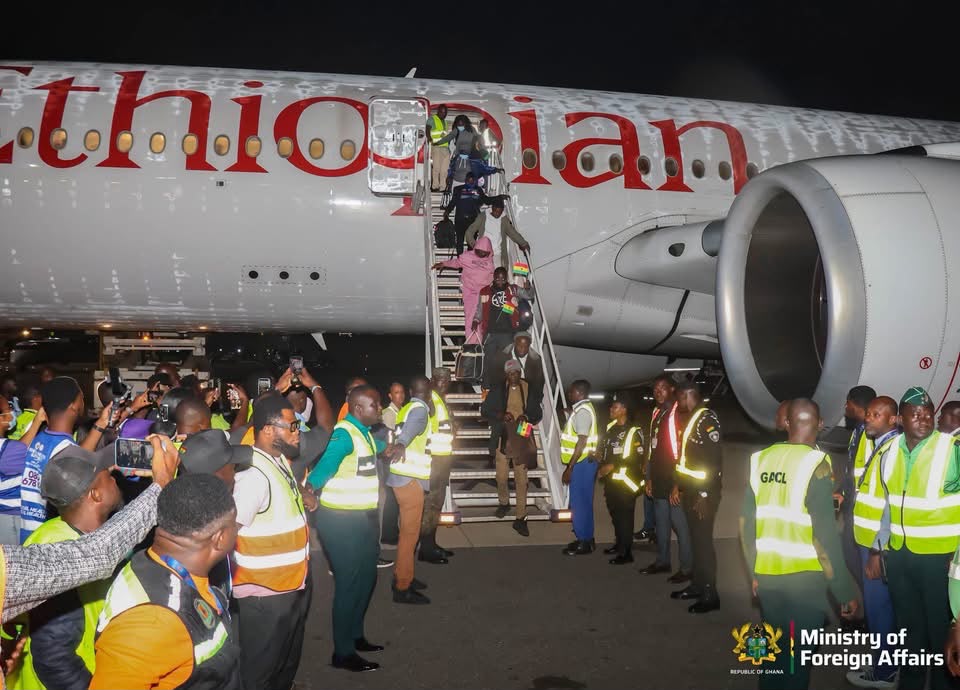
Ghana’s emergency evacuation operation from South Africa pressed forward on Saturday, as a second batch of three hundred and forty-five Ghanaians displaced by xenophobic attacks and anti-immigrant violence touched down at the Accra International Airport, bringing the total number of repatriated citizens to six hundred and forty-five.
The arrival, which took place on Saturday, June 6, comes days after the first batch of three hundred evacuees landed in Accra to emotional scenes of reunion and relief. Saturday’s reception carried a distinctly different tone, defined not by the raw emotion of a first homecoming, but by concrete government announcements signalling that Accra is now firmly in reintegration mode.
Beyond the Flight Home
Foreign Affairs Minister Samuel Okudzeto Ablakwa, who has anchored Ghana’s response to the xenophobic crisis from the very beginning, used Saturday’s reception to unveil the next stage of government support. He assured returnees that the government would actively facilitate employment opportunities for those willing and ready to work, revealing that an initiative had been launched inviting Ghanaian chief executives and entrepreneurs to take on evacuees as employees. The response, he noted, had been overwhelming, with around two hundred jobs already secured for returning nationals.

“We are going to make sure that for those of you who are willing, able, and ready to work, we will actively facilitate employment opportunities so you can work” he said”
Beyond employment, the Minister made a commitment that went further than many had anticipated. He disclosed that the government would not stand by without making every effort to secure compensation for evacuees who lost property, assets, businesses and shops due to the unrest. He indicated that legal processes were being put together to ensure that compensation is pursued for investments left behind in South Africa.
“The government of Ghana has decided that we are not going to sit back without any effort in attempting to secure compensation for those of you have have lost your property, lost your assets, your businesses, and shops, so we are putting together legal processes that we will activate to ensure that for those properties you invested in, we obtain compensation for you” he added.

A Multi-Sectoral Response
The presence of ministers from three key government sectors at Saturday’s reception underscored the breadth of Ghana’s reintegration effort. Gender Minister Agnes Naa Momo Lartey spoke directly to the emotional and psychological state of the returnees, urging them not to be defined by what they had endured. She told them that where there is life, there is hope, encouraging them to take advantage of all social interventions and opportunities available to them. Acknowledging the improvements taking place at home, she challenged the evacuees to channel into Ghana double the energy they had invested in South Africa, expressing confidence that the country holds more promise than the circumstances they are leaving behind.
Health Minister Kwabena Mintah Akandoh brought further reassurance, announcing that President Mahama had directed that the data of all arriving evacuees be captured to facilitate their free registration onto the National Health Insurance Scheme. For returnees who have endured weeks of physical danger and psychological distress, the guarantee of healthcare coverage upon arrival carries particular significance, ensuring that the trauma of displacement does not compound into a healthcare burden.
“His excellency the president has given instructions that we should take your data so that every one of you arriving from South Africa through this intervention will be registered for free National Health Insurance” he disclosed.

Taken together, the support package, two hundred jobs already secured, compensation being legally pursued, social protection interventions and free healthcare, represents a comprehensive framework for reintegration. It reflects a government that understands the return of its citizens as the beginning of a responsibility, not the end of one.
A Duty, Not a Favour
With over eight hundred Ghanaians having registered for evacuation and six hundred and forty-five now home, the operation still has ground to cover. But Ghana’s response to this crisis, from the diplomatic protest to the evacuation flights to Saturday’s reintegration announcements, carries a message that extends beyond logistics.
It is the message that citizenship is not conditional on geography. That a Ghanaian facing harassment in KwaZulu-Natal is as much the government’s responsibility as one walking the streets of Accra. And that the dignity of the African person, wherever on this continent they choose to live, work and build, must be defended with the same conviction that drove the liberation struggles of the twentieth century.
Six hundred and forty-five are home. A third batch of evacuees is expected to touch down on Sunday, June 7, a development that would bring the total number of Ghanaians repatriated from South Africa to nearly one thousand. More are on the way, and Ghana has made clear it will not rest until every one of them is accounted for.