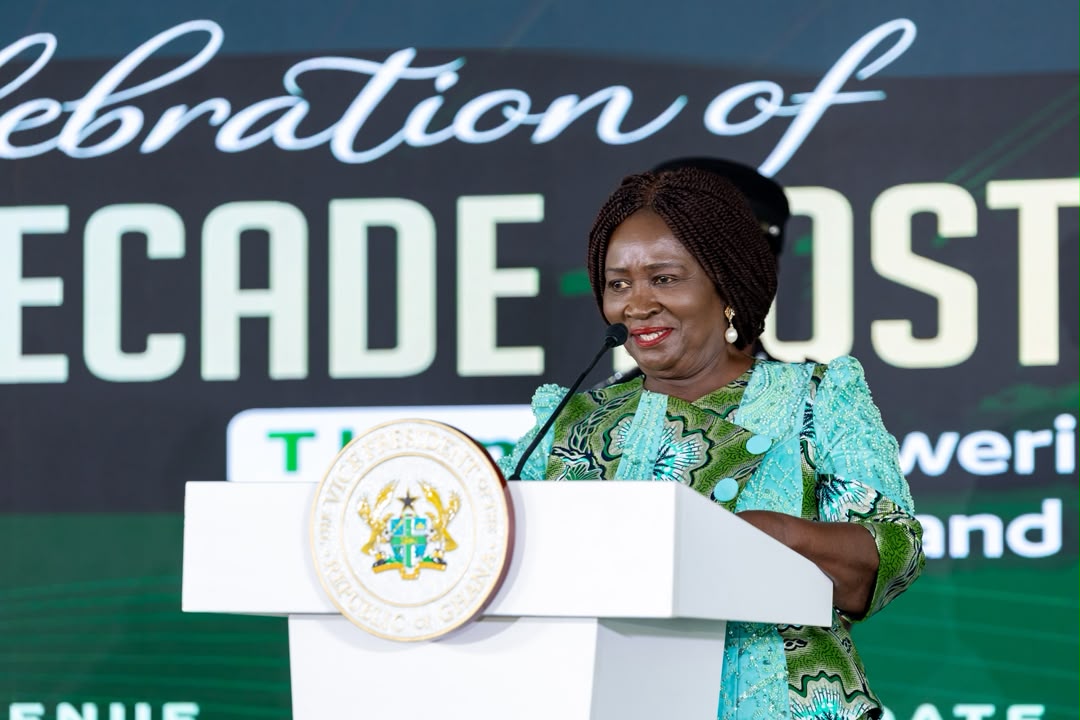
Vice President Professor Naana Jane Opoku-Agyemang says government is addressing the financial challenges in the energy sector through the settlement of outstanding arrears, renegotiation of power agreements and measures to improve payment discipline.
She said the interventions were aimed at easing the financial burden on the sector, restoring investor confidence and ensuring reliable and affordable electricity supply.
“Government has undertaken significant measures to address financial challenges in the energy sector, including the management of outstanding obligations and the renegotiation of agreements to improve sustainability,” she said.
The Vice President was speaking at the 10th anniversary celebration of Cenpower Generation Limited’s Kpone Independent Power Plant (KIPP), near Tema.

She cited the restoration of the World Bank guarantee for the Sankofa gas project, efforts to strengthen the Cash Waterfall Mechanism and the renegotiation of Power Purchase Agreements (PPAs) with Independent Power Producers (IPPs) as some of the measures being pursued.
“These measures are important for public finances and investor confidence, which are vital to Ghana’s energy security,” she said.
Prof. Opoku-Agyemang said government was also pursuing a gas-to-power strategy to increase the use of natural gas in electricity generation, reducing reliance on more expensive liquid fuels.
She explained that lowering the cost of power generation was necessary to sustain the energy sector and support businesses, industries and households.

The Vice President said reliable electricity remained central to the country’s economic development, particularly the government’s 24-Hour Economy agenda.
“The 24-Hour Economy requires more than the willingness of businesses to operate longer hours. Dependable electricity, efficient distribution networks and an energy sector capable of supporting increased production are all necessary,” she said.
She also pointed to government’s efforts to extend electricity access to underserved communities under the Big Push programme, citing an electrification project in the Volta Region expected to connect 206 communities to the national grid.
“Beyond generation capacity, we are working to ensure that electricity remains reliable, affordable and accessible, particularly for underserved communities,” she said.
The anniversary celebration also coincided with the announcement of an amended and restated Power Purchase Agreement between government and Cenpower.

Chairman of Cenpower’s Board, Mr Samuel Nana Brew-Butler, disclosed that the company had agreed to a US$66 million discount on arrears owed by government, which had at one point reached approximately US$400 million.
He said the agreement also provided for a 10-year extension of Cenpower’s existing PPA and a reduction in the tariff charged by the company.
About US$59 million had been paid to Cenpower in 2025 as part of government’s efforts to settle legacy debts owed to independent power producers.
Prof. Opoku-Agyemang commended Cenpower for its contribution to Ghana’s electricity generation and energy security, describing the Kpone plant as an example of what Ghanaian entrepreneurs could achieve through strategic partnerships and technical expertise.
She also acknowledged the company’s environmental and community initiatives, including efforts to address plastic pollution along the Sega Beach shoreline and educational programmes on waste management and biodiversity conservation for pupils.
She urged the company to sustain its engagement with surrounding communities and remain attentive to the environmental and social effects of its operations.