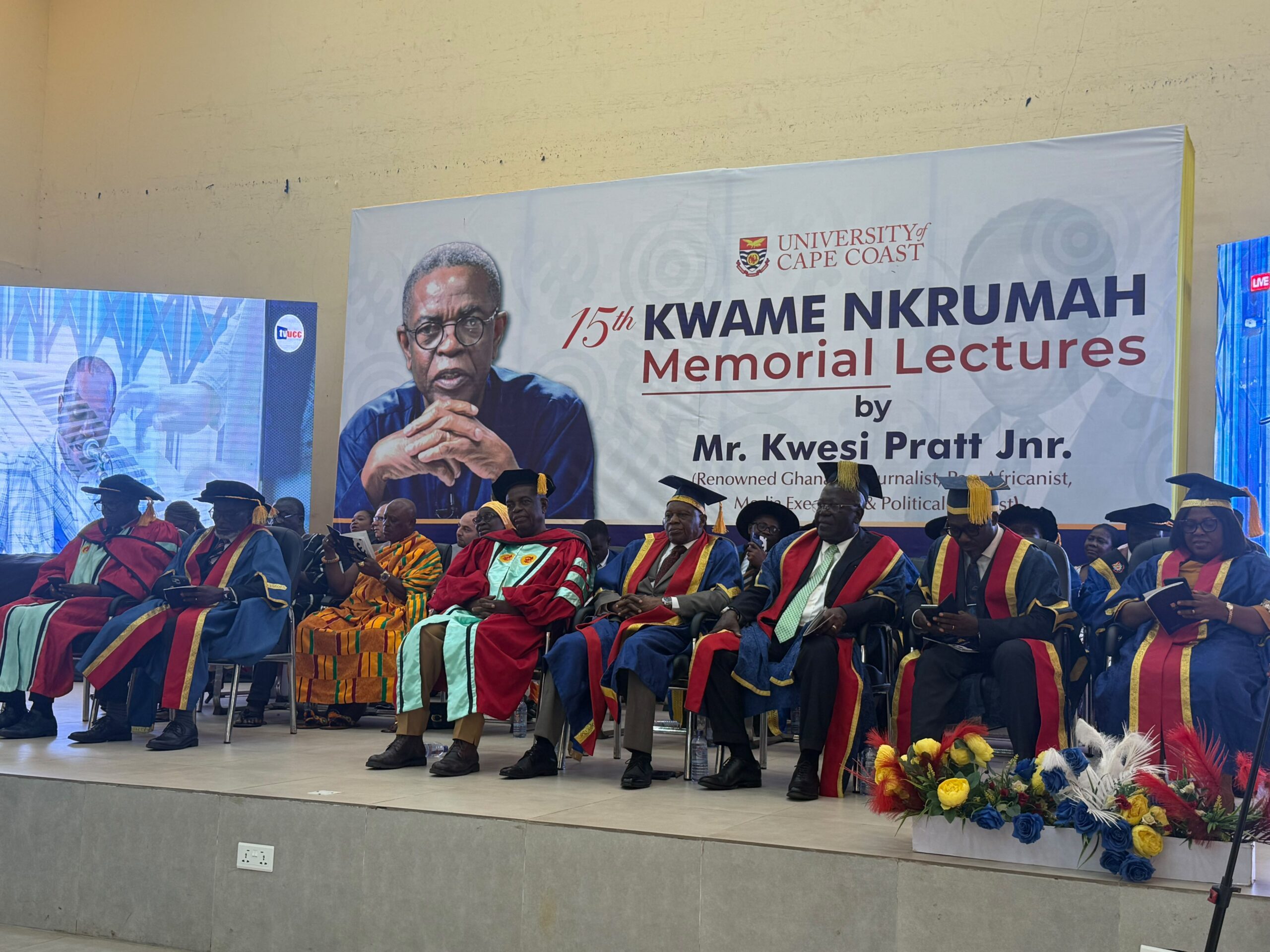

KWAME NKRUMAH MEMORIAL LECTURES — DAY ONE
UNIVERSITY OF CAPE COAST THURSDAY, SEPTEMBER 17, 2026.
THEME: KWAME NKRUMAH, YESTERDAY, TODAY AND TOMORROW: PERSPECTIVES ON CONSTITUTIONALISM, DEVELOPMENT AND PAN AFRICANISM
NATIONAL LIBERATION AND DEVELOPMENT STRATEGIST
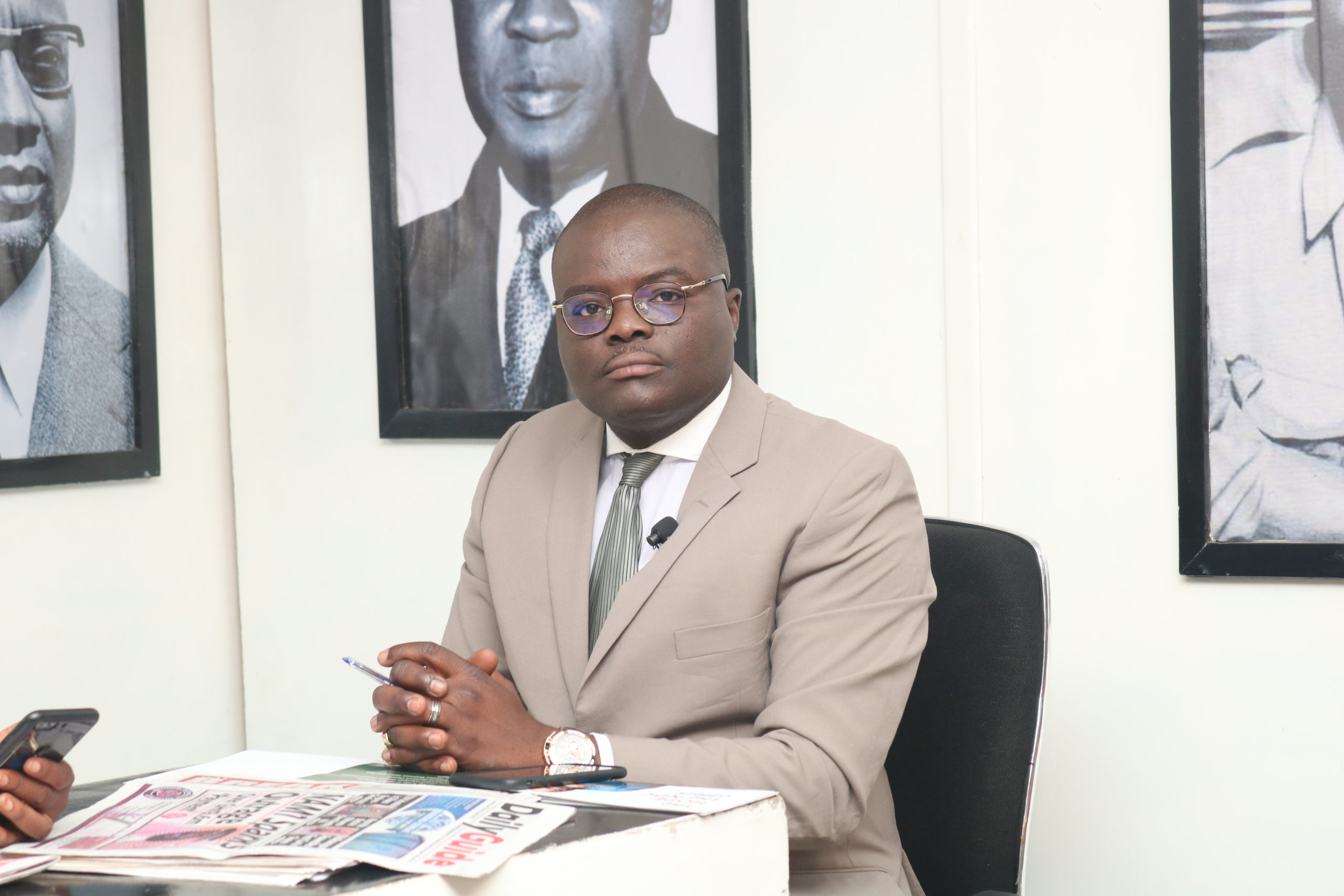
A Presentation By Kwesi Pratt, Jnr.
The Chancellor, the Vice Chancellor, lecturers, students and the entire university community.
I was about 12 years old when the disaster struck on February 24, 1966. According to accounts by former intelligence officers, John Stockwell and Philip Agee, the work of Richard D. Mahoney and declassified United States records, the Central Intelligence Agency and other agencies of the United States were deeply implicated in the overthrow of the government of Osagyefo Dr. Kwame Nkrumah. On that day, dark clouds hung low all over Africa as the coup makers, their imperialist sponsors and supporters set about destroying everything and anything about Nkrumah and his Socialist Pan-Africanist programme for the emancipation and development of Ghana and Africa. I joined a group of schoolmates and friends and we moved from Kotobabi Down to Abavana Junction, to Lagos Town, Kanda and Asylum Down, witnessing the brazen destruction of property and the physical abuse of innocent civilians suspected of loyalty to the Osagyefo.
In those moments, it was difficult if not impossible to imagine that 60 years on, a prestigious university like this one would institute annual lectures in memory of Africa’s man of all times. My wildest imagination could also not come close to a dream that me, who was being brought up in the alleys of Kotobaabi Down would be invited to deliver this lecture. I feel so very proud and honoured to have been invited to deliver this lecture. I profusely thank the University for this very special honour.
The Chairperson, what I want to do today is to focus attention on Nkrumah as a national liberation and national development strategist: on the constitutional road to Ghana’s independence, on the disciplined non-violence of Positive Action, on the constitutional choices made after independence and on the development programme intended to give political freedom an economic and social foundation to Ghana and Africa. Tomorrow’s lecture will turn fully to Nkrumah as a Pan-Africanist strategist and to the relevance of his ideas for African unity.
For Nkrumah, the anti-colonial struggle in Ghana and the Pan-African struggle were never separate enterprises. Ghanaian independence had to create a sovereign base from which the liberation and reconstruction of the whole continent could advance. That unity of national and continental purpose is the thread connecting these two lectures, and it has profound consequences for Ghana and Africa today.
In discussing Nkrumah, the formation of his ideas and the development of his strategy, we are not just making reference to historical memory, we are looking at political method. It asks us to examine how an oppressed people, denied sovereignty over their own land, could organise themselves, confront imperial power, and win the right to govern themselves. It asks us to understand how ideas became organisation, how organisation became mass action, how mass action forced constitutional change, and how constitutional change finally opened the road to independence.
The central argument of this presentation is clear: Kwame Nkrumah’s strategy for independence rested on three interconnected pillars. First, he transformed nationalism from an elite petitioning movement into a mass movement of workers, farmers, market women, youth, students, trade unionists and other working people. Second, he relied on disciplined, militant non-violence suited to the conditions of the Gold Coast. Third, he pushed constitutional change not as an end in itself, but as a step-by-step instrument for achieving full self-government and national independence.
Nkrumah’s Strategy for the Achievement of Independence, 1948–1957
The period between 1948 and 1957 was decisive in the making of modern Ghana. Before Nkrumah’s full emergence on the political scene, nationalist agitation in the Gold Coast was largely dominated by educated elites, lawyers, professionals, chiefs and merchants. They opposed colonial domination, but their methods were often cautious. They relied heavily on petitions, deputations, negotiations and constitutional appeals to the British colonial authorities.
The 1948 disturbances changed the political atmosphere dramatically. The shooting of ex-servicemen and the wider unrest that followed exposed the deep frustrations of ordinary people under colonial rule. Workers, traders, veterans and the urban poor were no longer prepared to wait indefinitely for reforms designed and delayed by the colonial power. The crisis revealed that the old style of politics was insufficient for a new historical moment.
It was in this context that Kwame Nkrumah’s role became decisive. After returning to the Gold Coast, he became General Secretary of the United Gold Coast Convention. The UGCC’s demand for self-government ‘in the shortest possible time’ was important, but Nkrumah considered it too cautious and too slow. For him, the people wanted freedom not at some undefined future date, but immediately. His slogan, ‘Self-Government Now,’ captured the urgency of the moment and connected directly with the mood of the masses. His famous demand to ‘seek ye first the political kingdom’ did not mean that political office was an invitation to enrich oneself or that economic transformation would occur automatically. It meant that a colonised people first had to seize sovereign power because, without control of the state, they could not reorganise production, education, health, infrastructure or their relations with the wider world.
Nkrumah’s great strategic innovation was to move the struggle beyond the drawing rooms of the elite and into the streets, markets, workplaces, schools and communities. He understood that colonialism was not simply a legal arrangement. It was a system of power. To defeat it, the nationalist movement had to become a popular force capable of making colonial rule unworkable.
This is why the formation of the Convention People’s Party in 1949 was such a turning point. The CPP gave organisational form to the demand for immediate self-government. It built branches, organised rallies, used newspapers, engaged trade unions, mobilised youth and women, and transformed political consciousness across the colony. The party did not wait for the colonial state to define the pace of change. It created pressure from below. This emphasis on organisation was deliberate. In Africa Must Unite, Nkrumah described the indispensable instrument of political revolution as a “strong, well-organized, broadly based political party.” The CPP was intended to be precisely such an instrument.
At the centre of this strategy was Positive Action. Positive Action was not random protest. It was a disciplined political method. It involved legitimate agitation, press campaigns, political education, strikes, boycotts and non-cooperation. Its purpose was to demonstrate that colonial authority depended on the cooperation of the colonised. Once the people withdrew that cooperation, colonial power would be exposed as fragile.
The colonial authorities responded to Positive Action with repression. Nkrumah was arrested and imprisoned. Yet this repression did not destroy the movement. Instead, it strengthened his standing among the people. His imprisonment became proof of sacrifice. His election victory while still in prison in 1951 became a powerful demonstration that colonial prisons could not imprison the will of the people.
Was Nkrumah a Pacifist?
Was Nkrumah a pacifist? The answer is no. His reliance on disciplined non-violence between 1948 and 1957 was not a moral absolute held for its own sake. It was a scientific method suited to the Gold Coast: a way to mobilise the masses, deny the colonial authorities a justification for a bloody crackdown, preserve international sympathy and make British rule politically and administratively untenable.
Mahatma Gandhi and the Indian struggle provided one important strand of this method, but not the only one. Nkrumah’s political formation also drew upon George Padmore, Marcus Garvey, the Black radical and diaspora traditions, trade unionism, socialism, anti-colonial nationalism and the British Left. He did not copy Gandhi mechanically. He selected from several traditions and adapted their lessons to the political realities of the Gold Coast.
The evidence of this influence is clear in the philosophy and practice of Positive Action. Nkrumah believed in mobilising the masses. He did not see liberation as the work of a few educated leaders alone. He believed workers, farmers, market women, students, youth and other citizens had to become the living force of the independence struggle. This was very close to Gandhi’s own belief that colonial rule could only be defeated when the masses became politically conscious and willing to act collectively. On page 104 of his book Consciencism, Nkrumah asserts: “Without Positive Action, a colonial territory cannot be truly liberated. It is doomed to creep in its petty pace from day to day towards the attainment of a sham independence that turns to dust, independence which is shot through and through with the supreme interest of an alien power.”
Third, both Gandhi and Nkrumah understood the importance of discipline. Non-violence was not weakness. It required courage, organisation and restraint. It was not passivity. It was active resistance. Nkrumah’s non-violence was therefore militant but disciplined. It confronted colonial power directly, but it sought to avoid the destructive consequences of armed struggle.
However, it is important to stress that Nkrumah’s non-violence was not purely Gandhian. It was also shaped by Pan-Africanism, trade unionism, socialism, anti-colonial nationalism and his understanding of imperialism. Gandhi’s influence provided an important method, but Nkrumah gave that method a distinctly African and revolutionary character.
Nkrumah’s non-violence was not an appeal to colonial kindness. It was a strategy to make colonial rule politically, morally and administratively unsustainable. It was based on the understanding that when the people are organised, disciplined and united, they can confront a powerful system without necessarily using armed force.
That is why disciplined non-violence in the Gold Coast and later support for armed liberation movements elsewhere in Africa were not contradictions. Different conditions required different tactics in the service of the same objective: real sovereignty. I shall return to that question tomorrow.
Constitutional Changes Advocated by Nkrumah Between 1948 and 1957
Nkrumah is often remembered as a mass mobiliser, but he was also a constitutional strategist. He understood that independence required not only protest, but also changes in the legal and political structure of colonial government. His attitude toward constitutional change was therefore practical and strategic.
After the 1948 disturbances, the colonial government was forced to accept that the old political structure could not continue unchanged. This led to investigations and constitutional proposals, including the Coussey Committee process. The reforms that followed were intended to give Africans greater participation in government, but Nkrumah and the CPP considered them inadequate because they did not transfer real power quickly enough.
Nkrumah’s position was not that constitutional reform was useless. Rather, he argued that constitutional reform without immediate movement toward self-government was a delaying tactic. He rejected reforms that preserved colonial control while pretending to offer political progress. For him, the test of any constitution was whether it transferred real authority to the people of the Gold Coast.
The 1951 Constitution was a major development. It created the conditions for elections and expanded African participation in government. The CPP contested the 1951 elections and won a major victory. Nkrumah, although still in prison, won his seat and was later released to become Leader of Government Business. This was a remarkable moment in colonial history: the man imprisoned by the colonial state became the person invited to lead government business because the people had given him their mandate.
The 1954 Constitution was another major step. It expanded internal self-government and strengthened the role of elected representatives. The 1954 elections again gave the CPP a strong mandate. This was crucial because Nkrumah could now argue that the demand for independence was not merely the view of one leader or one party; it was the expressed will of the people.
The constitutional debates of the mid-1950s also revealed serious disagreements about the future structure of the state. Some opposition forces, including regional and federalist tendencies, argued for greater regional autonomy. Nkrumah and the CPP favoured a strong unitary state. Their argument was that federalism, under the conditions of the time, could weaken national unity, empower sectional interests and delay independence. For Nkrumah, the immediate task was to build a united nation capable of resisting both colonial control and internal fragmentation.
The 1956 election became a final test of popular support for independence. Once again, the CPP’s victory strengthened the case for immediate independence. The British colonial authorities could no longer plausibly argue that the people of the Gold Coast were not ready for self-government. The road was cleared for independence on 6 March 1957, when the Gold Coast became Ghana. The culmination came at midnight on 6 March 1957, when Nkrumah could finally declare to the gathered crowd: “Ghana, your beloved country, is free forever!” The declaration was not simply ceremonial; it marked the constitutional transfer from colonial subjection to national sovereignty.
Nkrumah’s constitutional strategy can therefore be understood in stages: opposition to slow and limited colonial reforms; the demand for self-government now; participation in elections under the 1951 Constitution; the use of governmental office to expand African authority; the 1954 advance to internal self-government; the 1956 electoral mandate; and complete independence on 6 March 1957. He did not reject constitutionalism. He rejected colonial constitutional delay. He used mass action to force constitutional change, and then used constitutional change to move the country towards full sovereignty.
The 1960 Republican Constitution: The Debate After Independence
The constitutional story did not end with independence in 1957. The Independence Constitution still retained the British monarch as Ghana’s Head of State, represented locally by a Governor-General. For Nkrumah and the CPP, the move to a republic was therefore presented as the completion of political sovereignty: a Ghanaian people who had won independence should ultimately vest the highest authority of the State in institutions deriving their legitimacy from Ghana itself. In March 1960, the government published proposals for a Republican Constitution, and the National Assembly sat as a Constituent Assembly to consider them. On 27 April 1960, the electorate was asked both to approve the proposed republican constitution and to choose between Kwame Nkrumah and J. B. Danquah as the first President. The official results gave the constitutional proposal an overwhelming majority and elected Nkrumah as President, and on 1 July 1960 Ghana formally became a Republic.
The controversy lay less in the idea of republicanism itself than in the institutional design of the new Republic. The 1960 Constitution abolished the office of Governor-General and combined the functions of Head of State and Head of Government in an executive President. Article 8 vested the executive power of the State in the President and provided, subject to the Constitution, that he could act in his own discretion; Article 20 made Parliament consist of the President and the National Assembly. Supporters argued that a newly independent country facing regional tensions, political violence, economic transformation and the unfinished struggle against colonialism required a strong and coherent executive capable of acting decisively. Critics, however, warned that the concentration of authority in the Presidency weakened institutional checks and could turn popular sovereignty into executive supremacy. It is important to distinguish this debate from the later 1964 constitutional referendum: the 1960 Constitution created the Republic and the executive presidency; the formal one-party state came four years later.
This debate remains relevant to our own constitutional conversation. Was the 1960 Constitution principally the final constitutional act of decolonisation, or did it also open the door to an excessive concentration of presidential power? A serious answer must recognise both dimensions. The Constitution was submitted to the electorate and carried the authority of a popular vote, yet constitutional legitimacy cannot be measured by a plebiscite alone; it must also be judged by the durability of checks on power, and the conduct of political institutions. In that sense, the 1960 experience reinforces the point that no constitutional text enforces itself. The quality of constitutionalism depends not only on the words written into a constitution, but on the political culture, institutions and balance of social forces through which those words are made real.
Constitutionalism at Home
Constitutionalism is more than the existence of a written constitution. It involves government under law, popular sovereignty, accountable leadership, institutional limits, the protection of rights and meaningful participation by citizens. Nkrumah’s relationship with constitutionalism was complex. He helped use elections and constitutional reform to dismantle colonial authority, but after independence the demand for security and rapid transformation increasingly collided with civil liberty and institutional restraint.
Nkrumah also favoured a unitary state. His position was shaped by his fear that regionalism and ethnic politics could fracture the new nation and weaken the struggle for independence. He argued that the urgent tasks of national integration, industrialisation and social transformation required a strong central government. There was historical justification for the concern. The new state faced regional tensions, political violence, assassination attempts and intense Cold War interference. Several newly independent states were being destabilised, and the Congo crisis revealed the vulnerability of African governments to internal fragmentation and external manipulation.
The Preventive Detention Act of 1958 allowed the state to detain individuals without ordinary criminal trial. Opposition figures, political activists and others deemed threats to national security were detained under its authority. The Nkrumah government argued that preventive detention was required to counter bombings, attempted assassinations, violent conspiracies and threats to the stability of the young nation. His defenders also point out that emergency and preventive detention laws existed in other jurisdictions and had been used by colonial governments.
I have sometimes wondered whether those who criticise the introduction of the Preventive Detention Act expected Nkrumah to embrace the terrorists who desperately tried to kill him and wreck the Pan-African project and give them kisses on both cheeks. These were terrorists who exploded grenades in public places, stabbed CPP loyalists, destroyed national infrastructure and showed little concern for the age, ethnicity or gender of their victims. That violence must not be erased from the record. At the same time, detention without trial is a grave power, and a government that uses it must accept responsibility for its human consequences.
An article published on September 14, 2006, by Ekow Nelson and Michael Gyamerah, self confessed Nkrumaist, quoted a report by R.J. Vile, the Assistant Secretary and Head of West Africa Department at the Colonial Office after a visit to the Gold Coast in March 1955 as saying that “It is possible that Dr Nkrumah’s peaceful approach may lead to the resolution of the differences between the NLM and the CPP on constitutional matters…. but “it is quite possible that the core of determined young men will take to the forest and engage in guerilla warfare from there……”
The Protective Custody Decree issued by the National Liberation Council after Nkrumah’s overthrow was substantially similar in principle to the PDA, just as preventive and emergency powers have been used by many Western states when they claim to face grave security threats.
Constitutionalism Under the 1992 Constitution
Please permit me to recall what I told the Constitutional Review Committee chaired by the Rt. Hon. former Speaker of Parliament, Professor Mike Oquaye. This is within the context of the current noise about constitutional review. ‘There is a constant tension between our economic reality and the ideology of our Constitution. And in that tension, the poor and the marginalised always lose out.’ I also argued that no formulation of words on a piece of paper will protect the poor against a rapacious elite. No Constitution enforces itself. Outcomes depend on how people behave around constitutions, especially governing elites. Often, calls for review and amendment are attempts to deflect attention from official misconduct, although genuine defects in the text must also be corrected.
The Chairperson, continual constitutional crisis cannot be explained by poor drafting alone, although defects in the text are real and must be corrected. The deeper problem is the subservience of our political class to special interests and the conduct of institutions around the Constitution. Since 1992, Presidents have overreached, tolerated the dissipation of national resources and ignored abuses of citizens’ rights. Parliament has too often colluded with the Executive, and the Supreme Court has not always approached constitutional law as a mechanism through which the powerless can check the excesses of the powerful. These patterns hold in place a system of foreign economic exploitation while political elites blame the Constitution for outcomes produced by their own choices.
Nkrumah’s National Development Vision and the Seven-Year Development Plan
The colonial economy inherited by Ghana was not designed to achieve economic sovereignty. It was structured primarily to export cocoa, gold, timber and other raw materials while importing manufactured goods. Infrastructure had been developed largely to transport commodities from production areas to the coast. Industrial capacity was limited. Technical skills were insufficient. Access to education and healthcare remained unequal. Nkrumah understood that political independence without transformation of this economic structure would be incomplete.
The Seven-Year Development Plan, covering 1963-64 to 1969-70, represented the most comprehensive expression of his economic vision. It sought to use science, technology, national planning and productive investment to transform agriculture and expand industry. Its six connected pillars were state-led industrialisation, economic diversification, agricultural modernisation, infrastructure, human capacity and an African economic purpose.
First was state-led industrialisation. Nkrumah believed that the state had to take responsibility for strategic investments that the domestic private sector lacked the capital or capacity to undertake. State enterprises were therefore created in manufacturing, agriculture, transportation and other sectors.
Second was economic diversification. Ghana’s heavy dependence on cocoa exposed the country to fluctuations in world commodity prices. Industrialisation was intended to reduce this vulnerability, create employment and retain more value within the national economy.
Third was agricultural modernisation. Nkrumah did not treat industry and agriculture as opposing sectors. Modern agriculture was expected to supply food, industrial raw materials, employment and export revenue. Mechanisation, research, irrigation and organised production were expected to raise productivity.
Fourth was infrastructure development. Roads, ports, electricity, communications, housing and water were regarded as foundations for productive activity rather than decorative achievements. The Akosombo Dam and Volta River Project became the most visible symbols of this approach. They expanded Ghana’s electricity-generating capacity and were intended to provide an energy base for industrialisation. Tema Harbour, Tema Township, industrial estates and transportation projects reflected the attempt to construct a modern productive economy.
Fifth was investment in human capacity. Education was treated as a national development instrument. Primary, secondary, technical and university education expanded. Teacher training and scientific education were essential because development required trained citizens, engineers, administrators, technicians, teachers and healthcare workers. This point is especially significant at the University of Cape Coast. This institution emerged from the determination to train the educators needed for Ghana’s expanding school system. It demonstrates that Nkrumah’s development strategy was not confined to factories and dams. It also invested in the human beings who would operate and sustain a modern society.
Michael Nunoo, an avowed Nkrumaist, in his contribution to the book “FIGHT BACK – A Response To Anti-Nkrumah Provocations” wrote that “Measured against its 1951 manifesto, the achievements of the CPP far exceeded expectations. According to Ministry of Education statistical data, enrollment in primary schools was 102,138 in 1950 that is before the CPP came to power. This figure increased to 456,290 in 1961 and to a phenomenal 1,137,495 in 1966. During the period 1951-61, enrolment in 12 assisted Secondary schools including Achimota and non-assisted schools increased from 2,776 and 3,319 to 9,882. By 1966, enrolment in public secondary schools had increased by more than three fold from 1951 to 139,984 in 1961, doubling to a remarkable 267,434 in 1966. Two university colleges were set up as part of the effort to create the human resource vital for accelerated development.
Sixth was African economic purpose. The Seven-Year Plan connected Ghana’s development with the advancement of Africa. Nkrumah believed that Ghanaian industrial capacity should eventually form part of a wider continental economy. The strengths of this development project are evident. It had long-term direction. It sought to break colonial dependency. It invested in infrastructure, education, energy, industry and social services. It treated the economy as something that could be deliberately transformed rather than passively managed.
But the plan also faced serious difficulties. The collapse of world cocoa prices in the mid-1960s severely reduced Ghana’s export earnings. External debt and repayment obligations increased. Shortages, inflation and dissatisfaction became more visible. Parts of the development programme exceeded the administrative and financial capacity of the state. Some investments created lasting national assets; others performed poorly. The correct lesson is not to abandon national planning or industrialisation, but to combine them with stronger management, accountability, technological competence, realistic sequencing and disciplined evaluation.
Responding to the Claim That Nkrumah Destroyed Ghana’s Economy
The claim, repeated by Nkrumah’s ideological opponents, that he simply destroyed Ghana’s economy is too crude to survive serious examination. What kind of economy had Ghana inherited? It was a dependent colonial economy built around the export of primary commodities. Its apparent strength depended heavily on cocoa prices determined outside Ghana. It had limited industry, limited technological capacity and insufficient access to education and social services. Nkrumah used accumulated reserves and borrowed resources to construct factories, electricity systems, schools, roads, universities, hospitals, housing, ports and public institutions. Some of those investments remain part of Ghana’s national foundation even today. It is therefore misleading to discuss the decline of reserves without asking what the money was used to build.
The correct economic question is not simply whether expenditure occurred. It is whether the expenditure created sufficient productive capacity, whether projects were efficiently managed and whether the country could meet the resulting financial obligations. Most investments were transformative and enduring. The collapse in cocoa prices aggravated internal weaknesses and exposed the continuing vulnerability of the economy. Nkrumah did not destroy a diversified, industrial and self-sufficient economy. He inherited a dependent commodity-export economy and attempted to transform it. That attempt produced major national assets.
The lasting question is why, decades after his overthrow, Ghana continues to struggle with many of the same structural problems: dependence on raw-material exports, limited industrialisation, foreign exchange pressure, debt, unemployment and reliance on imported manufactured goods.
If Nkrumah destroyed the economy, why have successive governments, operating under very different ideological banners, not fully resolved the same structural weaknesses? The persistence of raw-material dependence, limited industrialisation, foreign-exchange pressure, debt, unemployment and reliance on imported manufactures points to a deeper problem. It allows the argument itself to reveal the limits of a neo-colonial capitalist economic framework.
Conclusion and Bridge to Day Two
Nkrumah’s strategy at home was neither accidental nor one-dimensional. It joined mass mobilisation, disciplined non-violence and constitutional transformation to a planned assault on the colonial economic inheritance. He transformed nationalism from an elite conversation into a people’s movement; used strikes, boycotts, non-cooperation, political education and elections to advance sovereignty; and treated factories, electricity, schools, roads, universities, hospitals, housing and ports as instruments of liberation.
The lesson from this period is powerful. Freedom is not handed down by the powerful. It is won by the organised determination of the people. Ghana’s independence was not a gift from Britain. It was the result of struggle, sacrifice, leadership, political clarity and the awakening of popular power.
Ghana’s independence was therefore not an end in itself. At midnight on 6 March 1957, Nkrumah declared that ‘the independence of Ghana is meaningless unless it is linked up with the total liberation of the African continent.’ Tomorrow, I shall examine how Ghana was intended to become a forward base for that continental struggle and why the national and African projects formed one coherent strategy.
Thank you all very much for tolerating me. We shall continue this conversation tomorrow!