By Abdulhaq Ibrahim
Just when Ghanaians thought the burden of the infamous E-Levy had finally been lifted, another financial blow has arrived, this time not directly from government taxation, but from corporate policy.
The moment I saw MTN’s announcement, I felt a deep wave of anger, exhaustion, and disgust. It was the kind of frustration many ordinary Ghanaians know too well, the painful realization that no matter how hard people struggle to survive in this country, another burden always seems to appear waiting to squeeze the little they have left. Every day feels like a battle: rising prices, shrinking incomes, unreliable services, and endless deductions from already struggling citizens. So seeing yet another charge introduced on something as basic as moving your own money felt insulting, insensitive, and completely disconnected from the realities people are facing across Ghana today.
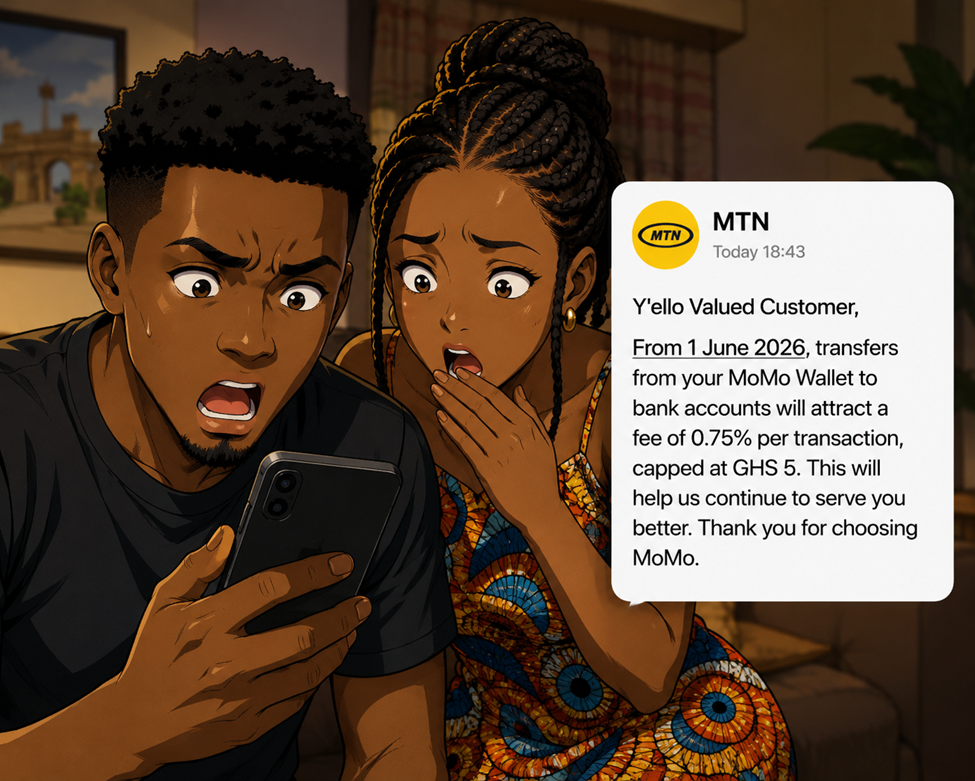
MTN Ghana’s decision to introduce a 0.75% charge on transfers from MoMo wallets to bank accounts, capped at GH₵5 per transaction, has sparked widespread anger and frustration among citizens already struggling under harsh economic conditions. For millions of Ghanaians who rely on Mobile Money for everyday survival, this policy feels less like a service adjustment and more like outright exploitation.

The concern is simple: why are Ghanaians being charged yet again just to move their own money?
For years, customers have already paid transaction charges for sending money to friends, family, businesses, schools, and service providers. Every transfer comes with deductions. Withdrawals come with deductions. Merchant payments attract fees. Yet despite the enormous revenues already generated from these services, MTN is now introducing an additional layer of charges targeting wallet-to-bank transfers, a service many users were encouraged to adopt in the name of financial inclusion and digital transformation.
This is what makes the decision particularly painful.
After aggressively promoting bank-wallet integration and encouraging users to connect their financial lives to the MoMo ecosystem, customers now feel trapped inside a system where every movement of money becomes another opportunity for corporate extraction.
And let us be clear: this is not happening because MTN is struggling financially.
Reports indicate that MTN Ghana recorded approximately GH₵1.7 billion profit after tax in the first quarter of 2025 alone. Its Mobile Money business reportedly generated more than GH₵1.3 billion in revenue during the same period. At the same time, the company commands over 29 million subscribers and more than 17 million active MoMo users across Ghana.
These are staggering figures.
This means the average Ghanaian is already contributing massively to MTN’s profitability every single day through airtime purchases, data subscriptions, transaction fees, and digital financial services. The introduction of yet another charge therefore raises an unavoidable moral and economic question:
At what point does profit become greed?
What makes matters worse is that many customers continue to endure inconsistent network quality, unstable internet connections, failed transactions, delayed reversals, and poor service delivery in several parts of the country. Ghanaians are therefore justified in asking why service frustrations continue to rise alongside corporate charges.
More importantly, this moment exposes a deeper national issue: the dangerous concentration of essential telecommunications infrastructure in the hands of profit-driven private corporations.
Telecommunications is no longer merely a business sector. It is now the backbone of economic activity, communication, digital finance, national data management, and public interaction. When a private entity gains such enormous control over the daily financial movements of millions of citizens, the consequences of unchecked corporate power become obvious.
This is why serious conversations must begin about the role of the state in managing strategic national infrastructure such as telecommunications and digital financial systems. A stronger public stake in telecom infrastructure could ensure that revenues generated from millions of users are reinvested into national development rather than primarily serving shareholder profits.
It could also strengthen accountability, data sovereignty, affordability, and universal access.
The anger surrounding these new MoMo charges is therefore not merely about percentages and transaction fees. It reflects growing public exhaustion. Citizens are tired of being squeezed from every direction while wages stagnate and the cost of living continues to rise.
Fuel prices increase. Electricity tariffs rise. Internet bundles shrink. Bank charges multiply. And now even access to one’s own digital wallet is becoming more expensive.
Ghanaians rejected the E-Levy because they believed financial survival should not be taxed at every point of transaction. If private telecom companies are now recreating similar burdens through corporate charges, then the spirit of public resistance against unfair financial extraction must remain alive.
Silence today will only encourage more charges tomorrow.
This is not merely about Mobile Money. It is about the future of digital finance, economic fairness, and the protection of ordinary citizens from systems that increasingly monetize every aspect of daily life.
Ghanaians must speak now, before digital convenience becomes digital captivity.
Will we continue accepting endless exploitation in silence, or will citizens finally take action before every telecom network follows the same path? Should Ghanaians begin boycotting MTN & MoMo transactions to send a clear message before they telecommunication networks take us for granted?