Story by George Yawson VINEH
The Inter-Ministerial Coordinating Committee (IMCC) on Decentralisation has reaffirmed the government’s commitment to deepening democratic decentralisation and strengthening Ghana’s local governance system.
The Committee says effective decentralisation remains critical to promoting accountable governance, responsive public service delivery and accelerated development at the local level.
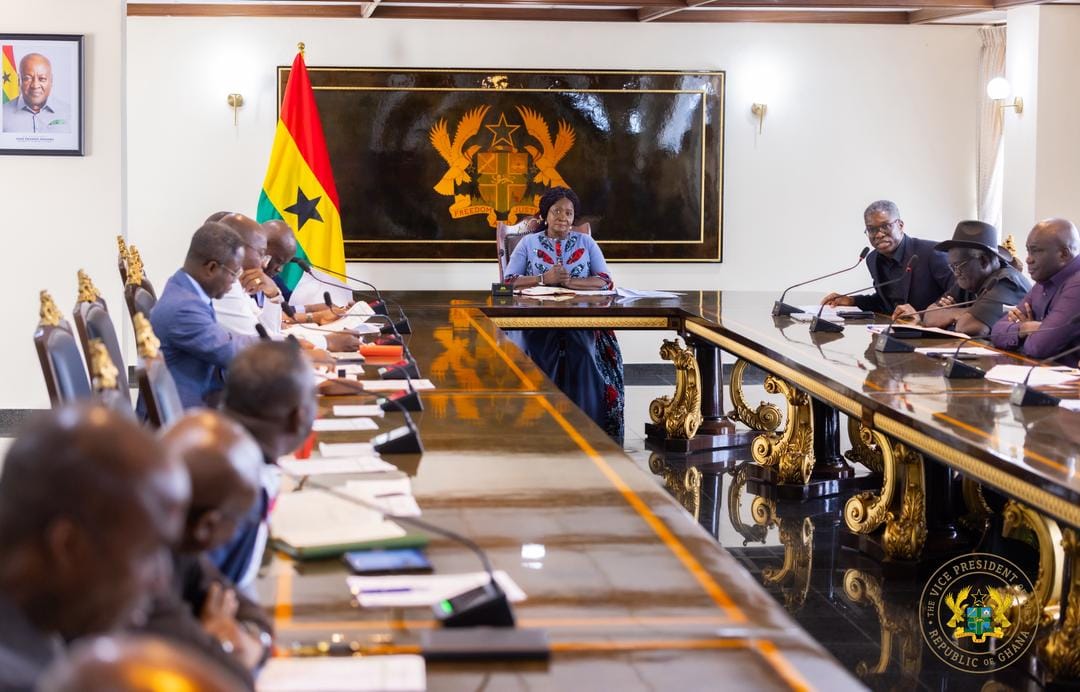
The commitment was reaffirmed at a high-level meeting of the IMCC held at Peduase Lodge on Monday, August 31, 2026, chaired by the Vice President, Prof. Naana Jane Opoku-Agyemang.
The meeting focused on strategic policy, institutional, legislative, financing and implementation priorities for advancing Ghana’s decentralisation agenda under the Local Governance Act, 2016 (Act 936).
In her opening remarks, the Vice President stressed the importance of bringing decision-making and public services closer to citizens, saying decentralisation must ultimately improve the welfare of Ghanaians and protect the environment.
She said citizen participation and inclusion must remain central to the decentralisation process and reaffirmed government’s commitment to advancing devolution and strengthening public participation in local governance.

Prof. Opoku-Agyemang also called for a shift from policy formulation to effective implementation, noting that the approval of the National Decentralisation Policy and Strategic Framework (NDPS 2026–2030) provides a critical foundation for reforms.
She emphasised that the success of the framework would depend on translating its objectives into tangible improvements in communities across the country.
The meeting received an update from the Executive Secretary of the IMCC, Dr. Gameli Kewuribe Hoedoafia, on measures being undertaken to create the necessary conditions for implementing the National Decentralisation Policy and Strategic Framework.
Dr. Hoedoafia said the Secretariat, in collaboration with Ministries, Departments, Agencies and other stakeholders, is advancing legislative and administrative reforms.
These include ongoing work on the review of the Local Governance Act, 2016 (Act 936), the Pre-Tertiary Education Act, 2020 (Act 1049), as well as the legislative framework governing the Ghana Health Service and Teaching Hospitals.
The IMCC also highlighted the need for increased public awareness and citizen engagement, recognising that successful decentralisation requires citizens to understand, participate in and take ownership of the reforms.

Financing local development
Financing emerged as a key issue during the meeting, with the Committee considering measures to strengthen the financial capacity of Metropolitan, Municipal and District Assemblies (MMDAs).
The discussions included increasing District Assemblies Common Fund allocations to MMDAs, improving internally generated revenue and expanding the fiscal space available to local authorities to finance development and public services.
The Committee also considered ways of mainstreaming decentralisation priorities into sector plans and budgets to ensure that resources are aligned with the objectives of the decentralisation programme.
Devolution of key sectors
The meeting further examined progress towards the devolution of key sectors, including education, health and roads.
Participants noted that the effective transfer of functions to the local level must be supported by the necessary legislative frameworks, financial resources, institutional capacity and accountability mechanisms.
The IMCC stressed that devolution without adequate resources and institutional capacity could undermine efforts to improve service delivery at the local level.
The Committee therefore called for a coordinated, whole-of-government and whole-of-society approach involving central government institutions, the Local Government Service, MMDAs, development partners, civil society organisations, traditional authorities, academia and citizens.

It reaffirmed its commitment to providing strategic policy coordination and oversight to accelerate implementation of the National Decentralisation Policy and Strategic Framework (2026–2030).
The priorities include effective devolution, sustainable financing, stronger institutional coordination, increased citizen participation and measurable improvements in local governance and public service delivery.
The meeting was attended by members of the Committee and other stakeholders, including the Chairperson of the IMCC Technical Committee, Prof. Kwamena Ahwoi, and the Administrator of the District Assemblies Common Fund.
The IMCC said it would continue working with relevant institutions and stakeholders to ensure decentralisation becomes a practical instrument for inclusive development, accountable governance and improved service delivery across Ghana.
The IMCC is established under Section 204 of the Local Governance Act, 2016 (Act 936), as the key national institutional mechanism for inter-sectoral policy coordination on decentralisation and Ghana’s decentralised local governance system.