Story by George Yawson VINEH
The new Minister for Local Government, Chieftaincy and Religious Affairs, Mahama Ayariga, has called for a comprehensive overhaul of Ghana’s waste management system to improve the collection, transportation, treatment and final disposal of waste.
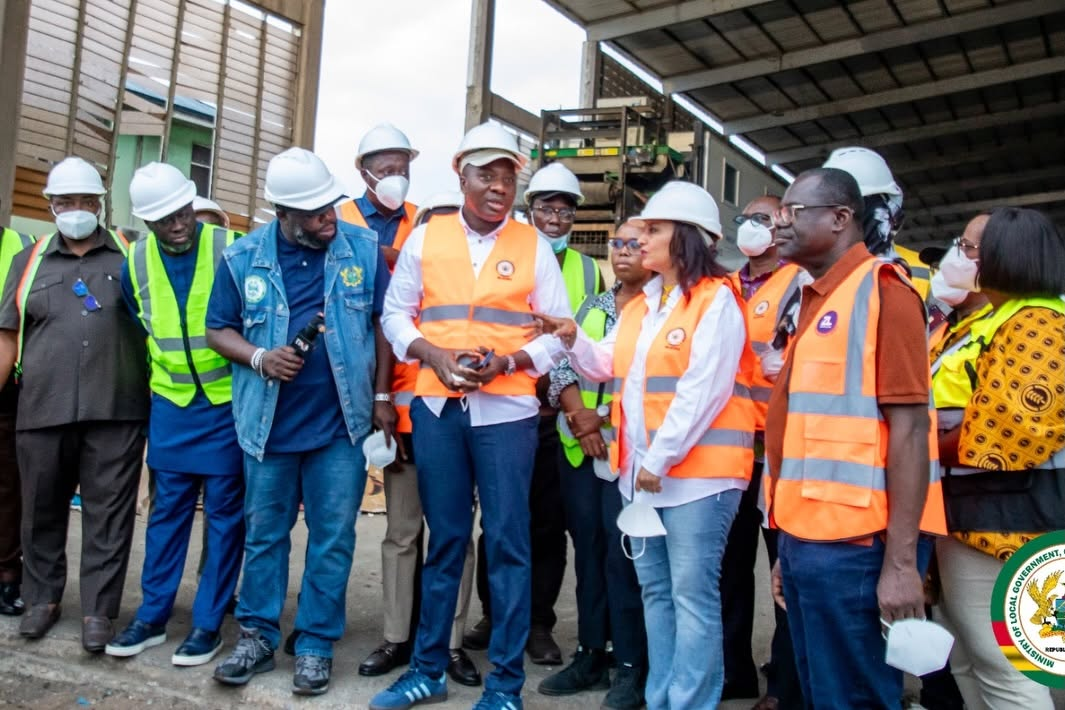
The Minister made the call after an early-morning tour of key waste management facilities in the Greater Accra Region on Tuesday, September 1, 2026.
The facilities visited included the Accra Compost and Recycling Plant (ACARP), Achimota and Jamestown Waste Transfer Stations, as well as the Kpone landfill site. The tour formed part of his initial engagements with facilities under the local government sector to assess challenges within the waste management chain and identify areas requiring investment and reform.
Mr Ayariga said the assessment had exposed significant gaps in the existing system, particularly in the collection, transportation and management of waste.
“There are clearly a lot of gaps in terms of the systems that we have for collecting and managing waste.”
Focus on waste separation
According to the Minister, reforms must begin at the household level, where different forms of waste are often mixed together before collection.

He said government would work towards introducing systems that encourage households to separate waste at source, supported by appropriate bins and receptacles.
Mr Ayariga explained that separating waste from the point of generation would make collection, transportation, recycling and treatment more efficient.
He also proposed bringing waste transfer stations closer to communities to reduce the distance waste collection trucks travel.
He said treatment and composting facilities should similarly be strategically located closer to urban centres as part of a more efficient waste management network.
Infrastructure and technology available
The Minister noted that Ghana already has much of the infrastructure and technology required to improve waste management, but stressed that better organisation of the system was necessary.
He said the challenge was therefore not simply the absence of facilities, but how the entire waste management chain was coordinated and managed.
Mr Ayariga’s position comes amid growing concerns over sanitation, waste disposal and the impact of poor waste management on urban communities.
The Ghana Institution of Engineering has also previously called for dependable waste collection services, stronger enforcement of sanitation laws and better integration of waste management into broader flood-prevention measures.

Investment and public responsibility
The Minister’s tour also involved officials of the Arab Bank for Economic Development in Africa (BADEA), as the government explored possible investment and development support for the sector.
BADEA Vice President for Operations and Secretary General, Dr Fatima Elsheikh, expressed the institution’s willingness to support Ghana’s efforts to build a more sustainable waste management system.
She noted that waste management should not be viewed solely as an environmental challenge, but also as an opportunity for job creation, improved livelihoods and economic development.
Mr Ayariga has also indicated that improving sanitation will require greater public responsibility, alongside investment in infrastructure and better systems.
The government is expected to launch a nationwide campaign aimed at addressing poor sanitation practices and encouraging citizens to take greater responsibility for waste management.
The Minister’s call signals a shift towards addressing Ghana’s waste management challenges through a comprehensive system covering waste generation, separation, collection, transportation, recycling, treatment and final disposal.
He said with the appropriate organisation, investment and public cooperation, Ghana can build a more efficient and sustainable waste management system capable of keeping its cities cleaner while creating economic opportunities.