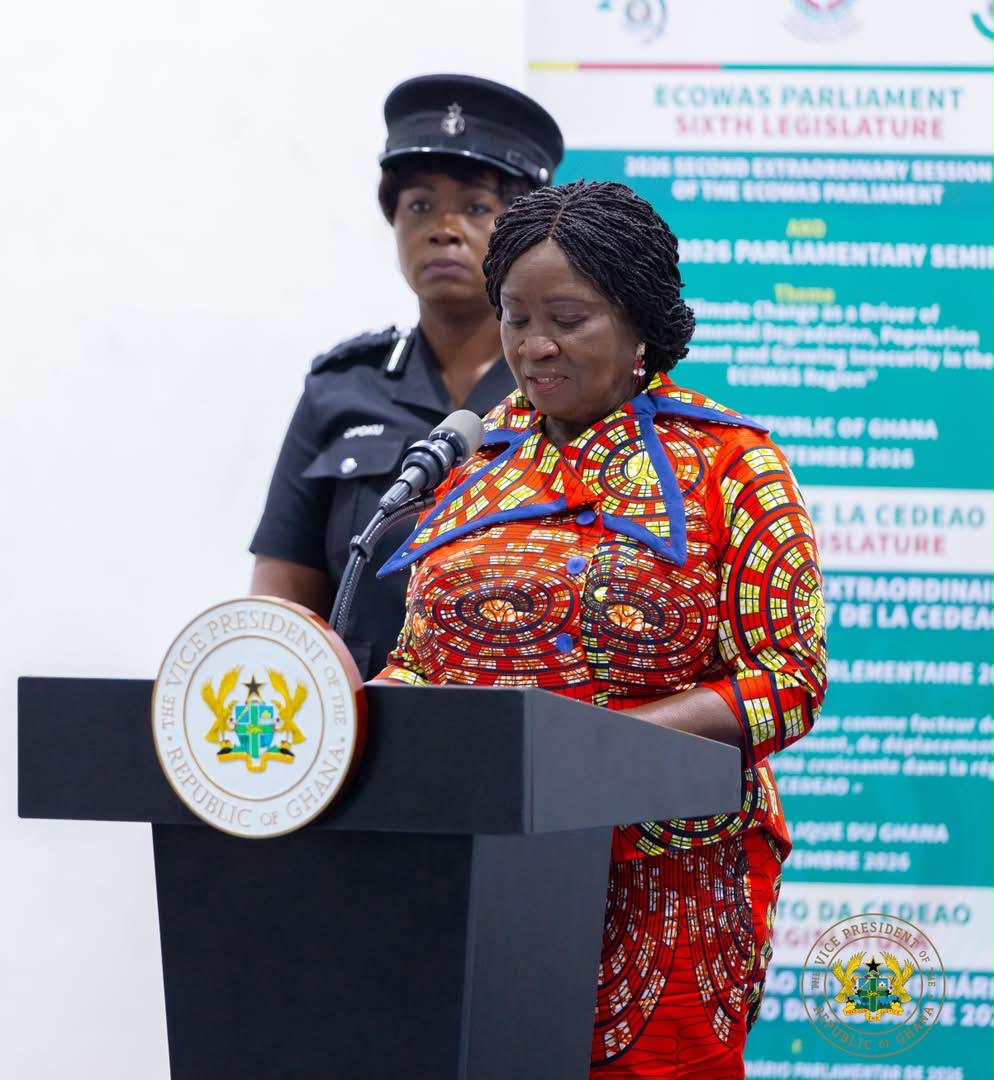
Vice President Professor Naana Jane Opoku-Agyemang has stressed the need for greater investment in opportunities for young people to help prevent their recruitment and exploitation by criminal and extremist groups.
She said prolonged exclusion and limited prospects for education, employment and decent livelihoods could create conditions that criminal and extremist groups exploit, making investments in education, skills development and community empowerment critical to peace and stability across the ECOWAS region.
The Vice President made the remarks in Accra on Tuesday when she opened the Second 2026 Extraordinary Session and Second Parliamentary Seminar of the ECOWAS Parliament.

She said the interconnected challenges of insecurity, environmental degradation, climate change and population displacement required coordinated regional responses.
“When young people face prolonged exclusion and limited prospects for education, employment, or a decent living, criminal and extremist groups can exploit their frustrations,” she said.
“That is to say, creating opportunities, strengthening communities, investing in education and skills all amount to investing in peace.”
The Vice President said ECOWAS member states must strengthen cooperation and develop coordinated approaches that address both the immediate effects and underlying causes of insecurity and displacement.

She also called for stronger early warning systems, better support for host communities and more resilient livelihoods to prevent local pressures from developing into wider humanitarian crises.
Parliamentarians urged to prioritise youth and women
Speaking on behalf of the Speaker of Parliament, the Second Deputy Speaker, Andrew Amoako Asiamah, said parliamentarians were uniquely positioned to bring the concerns of citizens into regional policymaking.
He said lawmakers heard directly from farmers affected by declining productivity, communities facing floods and droughts, displaced persons seeking safety, and young people vulnerable to unemployment and recruitment into criminal networks.
“These experiences must inform our legislative choices,” he said.

Mr Asiamah urged parliamentarians to promote legislation on environmental governance, climate adaptation, disaster preparedness and natural resource management, while strengthening regional cooperation on displacement and the protection of displaced persons, refugees and host communities.
He said young people and women must be placed at the centre of regional responses by creating opportunities in climate-smart agriculture, renewable energy and entrepreneurship.
The Second Deputy Speaker stressed that no single ECOWAS member state could address the region’s challenges alone, noting that rivers, ecosystems and environmental crimes crossed national borders.
He therefore called for stronger regional cooperation and adequate financing for sustainable development, climate adaptation, peace and security.

The Vice President further urged ECOWAS to ensure that existing frameworks on free movement, disaster risk reduction, climate action and early warning were fully implemented and properly resourced.
She said Ghana was working with ECOWAS to strengthen early warning through improved data sharing, closer coordination and stronger links between national and regional response systems.
The Second 2026 Extraordinary Session and Second Parliamentary Seminar of the ECOWAS Parliament is bringing together lawmakers to deliberate on climate change, environmental degradation, population displacement and insecurity and their implications for the region.
The extraordinary session will also provide a platform for deliberations on matters of importance to the Community, including the 2027 budget of the ECOWAS Parliament.