By Victoria Wilson |
Photo: Sylvain Liechti / MONUSCO Photos / Wikimedia Commons (CC BY-SA 2.0)
On 26 June 2026, the Democratic Republic of Congo filed a case at the International Court of Justice against Rwanda, alleging a campaign of genocide and serious, widespread human rights violations conducted from 1996 to the present day. It is the third time the DRC has attempted to hold Rwanda legally accountable at The Hague. The first case was withdrawn in 2001. The second was dismissed in 2006 for lack of jurisdiction.
The day before the ICJ filing, the United States Treasury sanctioned a Rwandan gold refinery and five associated entities for smuggling conflict minerals from eastern DRC. The minerals are extracted, in large part, from mines controlled by the March 23 Movement (M23), Rwanda’s proxy force in the east.
WHAT THE DRC FILED
Justice Minister Guillaume Ngefa submitted the application, invoking four international conventions: the Genocide Convention of 1948, the Convention on the Elimination of All Forms of Racial Discrimination, the Convention on the Elimination of All Forms of Discrimination against Women, and the Convention Against Torture. The DRC is requesting that the court order Rwanda to cease all violations and pay full reparations to both the state and its victims.
The ICJ case sits alongside proceedings already before the African Court on Human and Peoples’ Rights and the East African Court of Justice. Kinshasa is pursuing accountability on three fronts simultaneously.
Rwanda has consistently denied backing any armed groups in the DRC. Its foreign minister, Olivier Nduhungirehe, has described Rwanda’s presence in eastern DRC as an “intervention” justified by the threat posed by the Democratic Forces for the Liberation of Rwanda (FDLR), a Rwandan Hutu militia that has operated in the DRC since the aftermath of the 1994 genocide. The United Nations Group of Experts, Western governments, and multiple international monitoring bodies have documented Rwandan Defence Force (RDF) support for M23, including the provision of weapons, supplies, advanced military technology, and embedded RDF personnel fighting alongside M23 units.
THE AGREEMENT THAT WAS SUPPOSED TO END THIS

Photo: Freddie Everett / U.S. Department of State (Public Domain)
On 27 June 2025, almost exactly one year before the ICJ filing, the foreign ministers of the DRC and Rwanda signed the Washington Accords for Peace and Prosperity in Washington DC. The agreement committed Rwanda to withdrawing its forces from eastern DRC and ending support for M23. The DRC committed to neutralising the FDLR. In exchange, a critical minerals framework was established: the United States would receive preferential access to Congo’s reserves of coltan, cobalt, copper, and lithium, and a joint US-DRC governance mechanism would oversee the management of Congo’s mining sector.
The full US-DRC Strategic Partnership Agreement was signed on 4 December 2025. According to the Oakland Institute, whose report “Shafted: The Scramble for Critical Minerals in the DRC” examined the deal in detail, the agreement requires the DRC to amend its national laws and potentially its constitution to accommodate the US governance role. The deal also faces a constitutional challenge in Congolese courts.
One year after the Washington Accords were signed, Rwandan forces have not withdrawn from eastern DRC. In January 2026, M23 seized Goma, the capital of North Kivu Province. In February 2026, it seized Bukavu, the capital of South Kivu Province. M23 now controls a territory comparable in size to the state of Connecticut, where it has established local administrations. By March 2026, US Treasury Secretary Scott Bessent publicly demanded “the immediate withdrawal of Rwanda Defence Force troops, weapons, and equipment”, an explicit acknowledgement that Rwanda had not complied. The 6th Joint Oversight Committee meeting under the Washington Accords, convened in June 2026, produced de-escalation statements. No withdrawal followed.
RUBAYA: THE MINE THAT FUNDS THE OCCUPATION
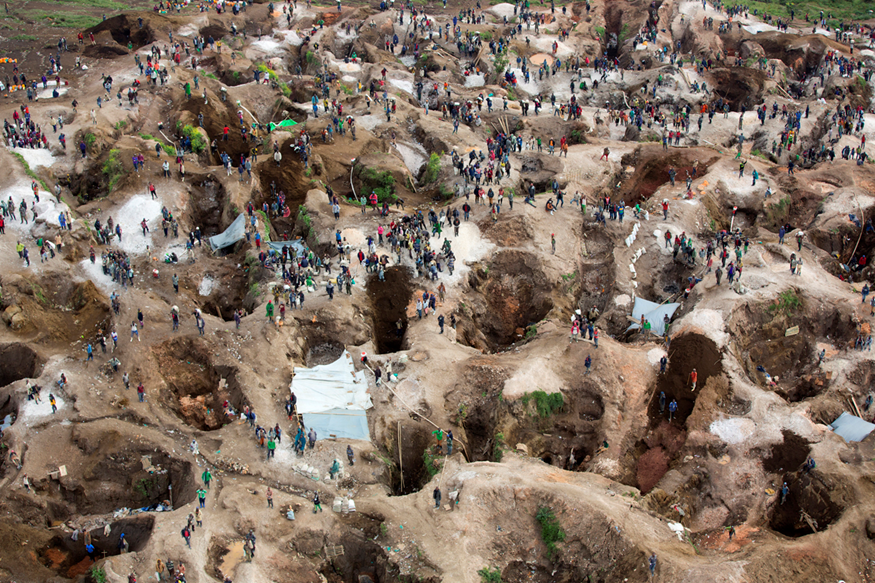
The Rubaya coltan mine in North Kivu is the largest coltan producer in the DRC, supplying approximately 15 percent of the world’s tantalum, a mineral used in the capacitors that power consumer electronics worldwide. M23 has controlled Rubaya since April 2024. It imposes taxes on coltan production and trade at the site, collecting an estimated $800,000 per month.
Since the beginning of 2026, Rubaya has also become the site of mass industrial death. On 28 January, heavy rains triggered landslides at the Luwowo mining site. More than 400 people were confirmed dead by 2 February, artisanal miners, children, traders, and residents of the surrounding villages. The mine tunnels at Rubaya are dug by hand with no safety procedures, no maintenance standards, and no regulatory oversight. Workers earn approximately one dollar for fourteen hours of labour. On 4 March, a second landslide killed more than 200 people, including approximately 70 children, according to the Congolese mines ministry. At least four landslides in 2026 have killed hundreds in total at the site.
The coltan extracted at Rubaya is transported across the border into Rwanda, where it enters international trade flows with its conflict origins obscured. From Rwanda, the minerals travel to refining hubs across Asia and beyond, eventually reaching the components that power consumer electronics worldwide. The DRC’s mines minister acknowledges the country loses an estimated 60 tonnes of gold per year to smuggling through Uganda, Rwanda, and the UAE.
The US Treasury action on 25 June 2026, one day before the ICJ case was filed, sanctioned Gasabo Gold Refinery LTD and its chairman Jean Malic Kalima, general manager Bosco Kayobotsi, and three additional Rwandan mining entities. The US Embassy in Rwanda described the sanctions as supporting the Washington Accords. The Oakland Institute has argued the reverse: that the Washington Accords, by inserting the United States as a privileged partner in Congo’s mining governance, give Washington a structural interest in the continuation of the extraction economy that M23 and Rwanda have built, and that as long as Rwanda functions as a processing and re-export hub for Congolese minerals, neither the RDF nor M23 faces a compelling incentive to withdraw.
THE POSITION OF THE UNITED STATES
The United States brokered the peace deal. The United States secured preferential mineral access through the deal. The United States is now sanctioning Rwanda for violating the terms of the deal, specifically for smuggling minerals whose extraction funds the military force the deal was supposed to remove.
The Institute for Security Studies has argued that minerals-for-security frameworks have historically failed to end resource-driven conflicts. The Centre for Strategic and International Studies described the DRC-Rwanda agreement as a deal that fails to address the root causes of the conflict. US companies moved to position themselves for mineral access in the DRC as negotiations were still underway, according to Responsible Statecraft.
Eight million two hundred thousand people were displaced in the DRC by September 2025. The figure is projected to reach nine million by the end of 2026. The First Congo War, which Black Agenda Report and investigative author Judi Rever trace to October 1996, produced the conditions that the Washington Accords were signed to resolve. Those conditions, Rwandan military presence, M23 control of eastern territory, and industrial-scale mineral extraction without Congolese oversight or benefit, remain in place thirty years later.
The DRC’s ICJ application covers abuses “from 1996 to the present day.” The Rubaya mine is still open. The occupation is intact. The case has been filed.