By Victoria Wilson |
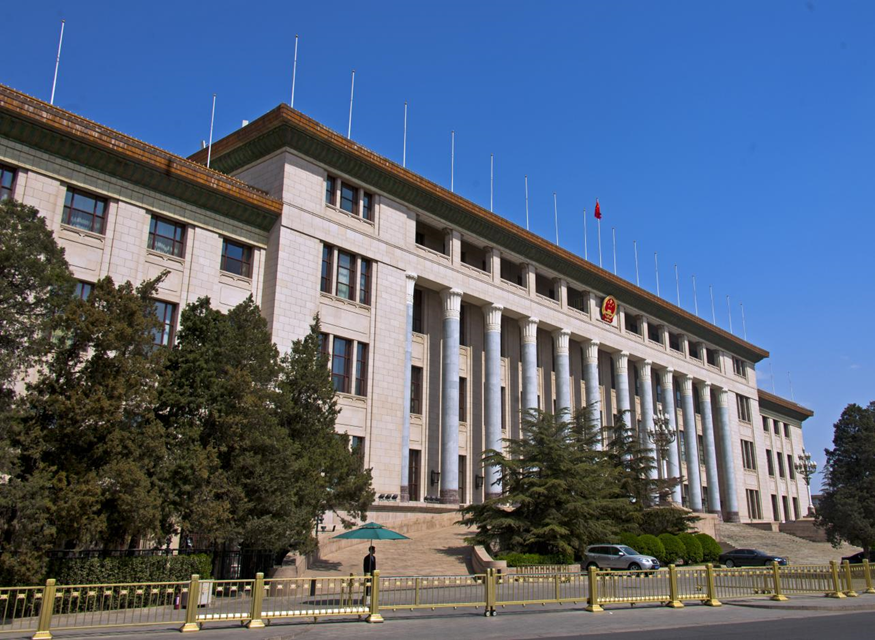
The Great Hall of the People has hosted Chinese state functions since 1959 and is where the two governments issued the Joint Statement elevating relations to a “Community with a Shared Future for the New Era.” Photo: Daniel Case / Wikimedia Commons (CC BY-SA 3.0)
Presidents Xi Jinping and Netumbo Nandi-Ndaitwah concluded a Beijing summit on 10 July by elevating China-Namibia relations to a “Community with a Shared Future for the New Era,” a framework both governments describe as aligning Namibia’s own Vision 2030 development plan with China’s modernisation drive. Eight cooperation documents were signed, extending a partnership that spans infrastructure, energy, mining, agriculture, education, science and technology, healthcare, aviation, space, and water resources.
Nandi-Ndaitwah’s seven-day visit, her first to China since taking office in March 2025, ran through Guangzhou, Shenzhen, and Chengdu before concluding in Beijing. Xi set out three principles for the mining relationship specifically, mutual benefit through complementary strengths, cooperation resolved through friendly consultation, and market-oriented exploration of new cooperation models. “China stands ready to work with Namibia to enhance exchanges of development philosophies and synergize development strategies,” Xi said. Nandi-Ndaitwah responded that Namibia “welcomes more Chinese enterprises to invest and operate in the country,” adding that “China has long provided selfless support and assistance to African countries.”
A Cooperation Record Already Built
The new minerals and green hydrogen agreements extend a partnership with a delivered track record inside Namibia. China Daily reported that the record includes a satellite ground data-receiving station in Windhoek, supporting disaster response and agricultural planning, and the Dr Hage G. Geingob Freeway, built with 54 Namibian construction companies and creating approximately 850 local jobs, which cut airport-to-city travel time from 50 minutes to 20. The same reporting cites the 100-megawatt Sores Gaib Power Station, generating more than 300 million kilowatt-hours annually, and Chinese-backed oyster farms operating in Walvis Bay using modern aquaculture techniques.

The Joint Statement signed in Beijing names the Port of Walvis Bay, the site of the Chinese-backed oyster farms, as a strategic gateway connecting Southern Africa to regional and global markets. Photo: Hp.Baumeler / Wikimedia Commons (CC BY-SA 4.0)

Namibia’s 2023 ban on unprocessed mineral exports set a target of processing 57 percent of mineral output locally by 2030, the sovereign development goal the Beijing agreements are intended to advance. Photo: Ikiwaner / Wikimedia Commons (GNU FDL 1.2)
Beijing extended zero-tariff access to all 53 African countries with which it holds diplomatic relations from 1 May 2026, covering processed and semi-processed goods alongside raw commodities. For Namibia specifically, that access now covers beef, seafood, grapes, and processed foods.
Building on Green Hydrogen
Nandi-Ndaitwah met Hyphen Hydrogen Energy chief executive Marco Raffinetti and leadership from China National Chemical Engineering Corporation in Chengdu on 8 July, two days before the Beijing summit. CNCEC holds the engineering, procurement, and construction contract for the first phase of Hyphen’s USD 9.4 billion green hydrogen project, Namibia’s flagship renewable energy undertaking, targeting 300,000 tonnes of green hydrogen annually once operational.
The 2023 export ban and its target of processing 57 percent of Namibia’s mineral exports locally by 2030 remain the foundation this partnership is meant to build on. The freeway that already cut Windhoek’s airport commute by more than half stands as one measure of what the cooperation has delivered so far.