By Makiza Micheline Latifa | June 12, 2026
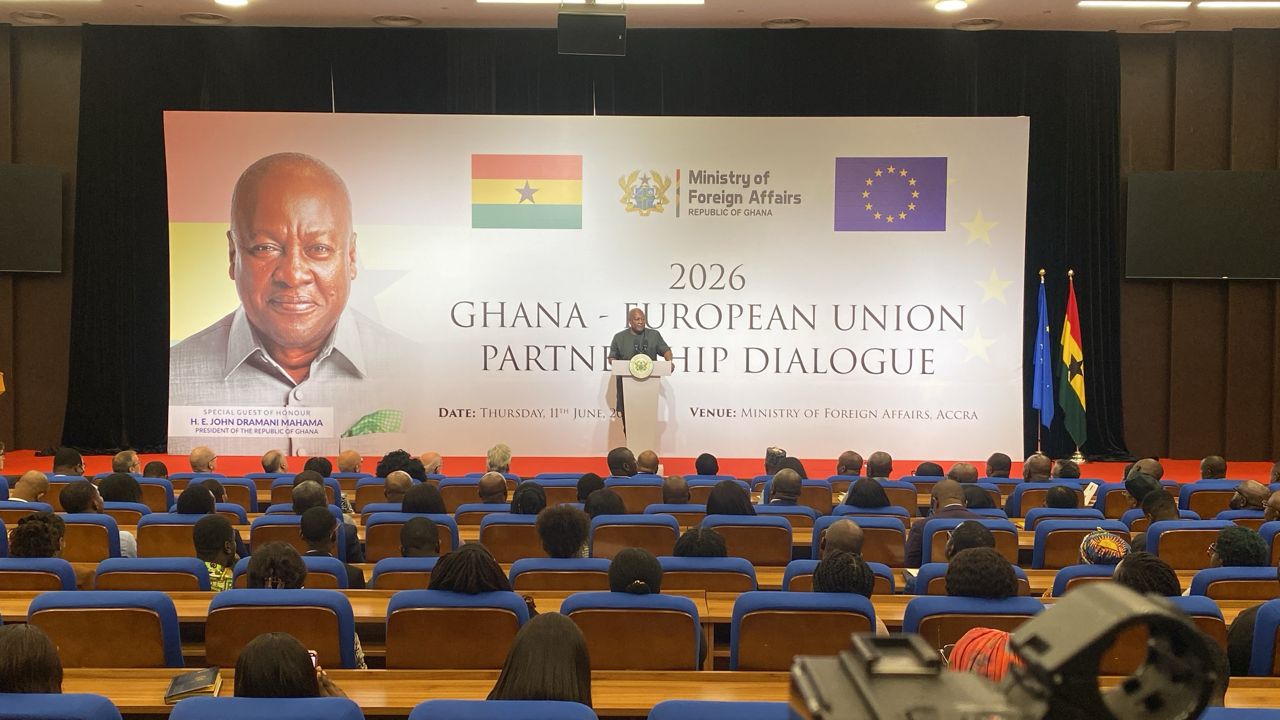
With shifting global alliances reshaping Africa’s diplomatic landscape, Ghana and the European Union have convened in Accra to redefine what their partnership looks like in an increasingly complex world. The 2026 Ghana–EU Partnership Dialogue, held at the Ministry of Foreign Affairs, brought together senior government officials, diplomats, development partners, and key stakeholders to examine emerging geopolitical realities, strengthen economic cooperation, and identify new opportunities for collaboration on development, security, and trade.
Foreign Affairs Minister Samuel Okudzeto Ablakwa set the tone early, framing the decades-long partnership as one built on demonstrated results rather than ceremonial affirmations. He pointed to two successes that Ghana chalked in the year under review as evidence of the partnership’s evolution.
“During the year under review, Ghana became the first African country to formalise a security and defence partnership with the European Union. Ghana also became the first African country to secure a sustainable timber certification,” he said.
On the economic front, the Minister was equally upbeat, noting that trade volumes had recorded significant year-on-year growth. “We are also delighted to note that the year under review, our trade volumes have seen a remarkable improvement, adding in excess of a billion dollars to our trade partnership. The EU remains a very cherished trading partner with Ghana,” Ablakwa added.

The most consequential address of the morning came from President John Dramani Mahama, who used the platform to articulate a vision for a fundamentally different kind of partnership, one that moves decisively away from the familiar donor-recipient dynamic that has long defined Africa’s engagement with Western institutions. “We must move from a partnership largely centred on aid and development assistance to one that is increasingly driven by trade, investment, innovation, industrialisation, and shared prosperity,” the President declared. Mahama grounded his call in Ghana’s own recent trajectory, noting that the country’s economic recovery provided both a proof of concept and a basis for greater ambition.
“When this dialogue convened last year, Ghana was emerging from one of the most challenging economic periods in our recent history. Today, our economy is showing encouraging signs of recovery and resilience, guided by our reset agenda,” he said.
For the President, the stakes extended well beyond Ghana’s borders. “As the world faces growing fragmentation, Ghana believes that partnerships such as ours must become stronger, more equitable and more strategic. Our objective should not be merely to maintain existing cooperation but to elevate it to a whole new level,” Mahama stressed.
The European Union’s representative in Accra signalled that Brussels was equally ready to shift gears. EU Ambassador to Ghana, Rune Skinnebach, acknowledged Ghana’s economic turnaround in terms that went beyond diplomatic courtesy. “We recognise and commend Ghana’s remarkable economic recovery and stabilisation in recent years. Ghana has outperformed several of the objectives set under the IMF support programme and demonstrated resilience in the face of severe socioeconomic challenges,” the Ambassador said, a pointed endorsement that carries weight at a moment when African nations are increasingly asserting the right to define the terms of their own economic partnerships.
The 2026 Ghana–EU Partnership Dialogue arrives at a moment of broader continental significance. Across Africa, governments are recalibrating long-standing relationships with traditional partners, demanding arrangements built on equity, sovereignty, and mutual benefit rather than dependency. Ghana’s twin firsts,
in security cooperation and sustainable timber certification, alongside a billion-dollar trade uptick, offer a template for what that recalibration can look like in practice.
Whether the commitments made in Accra translate into the structural shift President Mahama envisions will be the measure by which this dialogue is ultimately judged.