By Makiza Micheline Latifa
Can there be reparatory justice without accountability?
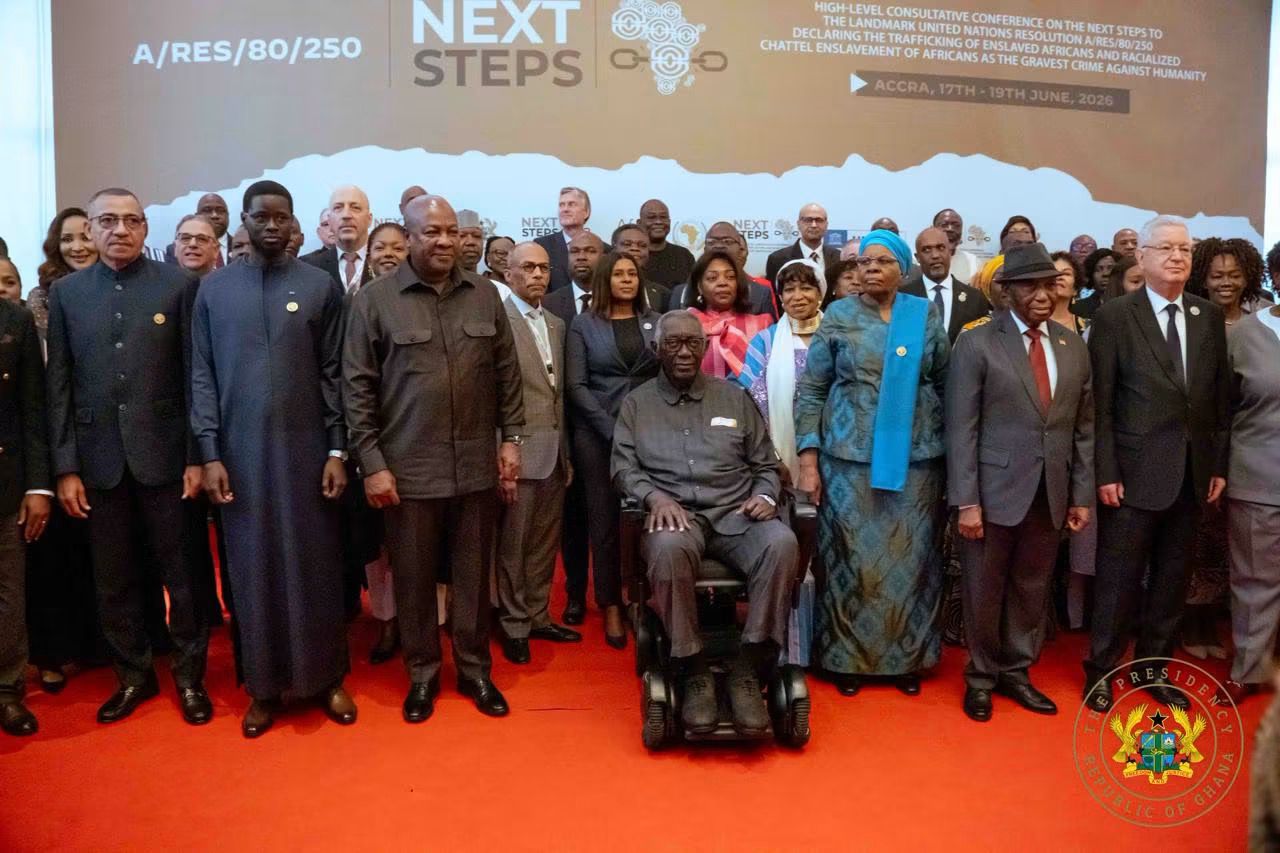
That question framed much of the discussion at the opening of the High-Level Consultative Conference on the Next Steps of the Landmark United Nations Resolution on the Trafficking of Enslaved Africans, as political leaders, scholars, activists and members of the African diaspora gathered in Accra to advance the global movement for reparations.
The conference follows the adoption of a historic United Nations resolution led by Ghana that recognized the transatlantic trafficking and enslavement of Africans as the gravest crimes against humanity, marking a significant milestone in decades of advocacy by African states, Caribbean nations and descendants of enslaved peoples across the world.
The opening ceremony brought together some of the most influential voices in the reparations movement, including Nobel Laureate Prof. Wole Soyinka, Chair of the CARICOM Reparations Commission Prof. Sir Hilary Beckles, UNESCO Assistant Director-General Lidia Arthur Brito, and several African heads of state.
Presidents Bassirou Diomaye Faye of Senegal, Netumbo Nandi-Ndaitwah of Namibia, Joseph Boakai of Liberia and Carlos Vila Nova of São Tomé and Príncipe joined Barbados Prime Minister Mia Amor Mottley and other leaders in delivering remarks that paid glowing tribute to the shared struggles of African peoples and the continuing fight for dignity, sovereignty and reparatory justice.

Held under the auspices of President John Dramani Mahama in his capacity as the African Union Champion for Reparations, the conference witnessed the establishment of an Advisory Council on Reparatory Justice, an Expert Panel on the Restitution of Cultural Artefacts and a Panel of Legal Experts for Reparatory Justice—key institutional mechanisms aimed at translating the growing global call for reparations into concrete action.
Germany and the Netherlands further participated in a symbolic restitution presentation, reinforcing growing international discussions around the return of cultural property and historical accountability.
Yet despite the presence of numerous global figures, it was French President Emmanuel Macron’s goodwill message that attracted the greatest attention.
His participation had already sparked criticism from Pan-African organizations and reparations advocates who questioned the decision to grant France a prominent platform at a conference dedicated to reparatory justice.
Critics have pointed to France’s historical role in the transatlantic slave trade, its colonial domination of vast territories across Africa, its treatment of Haiti following the Haitian Revolution, and more contemporary accusations of neo-colonial influence in parts of Francophone Africa.

Particularly contentious has been France’s abstention during the March 2026 United Nations vote on the Ghana-led reparations resolution, a decision many viewed as evidence of France’s reluctance to fully embrace the growing international consensus around reparatory justice.
Addressing delegates, Macron sought to position France as an active participant in the process of historical reckoning.
“The lasting legacy of the slave trade and plantation economies must be fully understood in all regions of the world that were affected,” he said, adding that remembrance was a responsibility shared by both the Global North and South.
“France intends to fully participate in this work.”
The French President also highlighted France’s recognition of slavery and the slave trade as crimes against humanity and argued that “the first reparation is truth.”
“For the first reparation is truth. Recognized truth that we stand by,” Macron stated.
He further called for greater efforts to restore the names, identities and stories of those erased by centuries of enslavement and colonial violence.
Macron also used the conference to propose what he described as a new international initiative to advance the reparations agenda.

“Along with Ghana and other countries or institutions that wish to participate, France would like to launch an international scientific initiative to formulate concrete recommendations and to support this movement of recognition,” the president said.
Yet the proposal underscored the contradiction at the heart of France’s participation in the conference. While France is now seeking a leading role in shaping global conversations on reparatory justice, France abstained from the landmark Ghana-led United Nations resolution earlier this year and has never formally apologized for its role in the transatlantic slave trade, the colonization of large parts of Africa or the crippling indemnity imposed on Haiti following its independence.
For many, the irony was difficult to miss. At a conference dedicated to confronting the enduring consequences of slavery and colonialism, one of Africa’s principal former colonial powers was presenting itself as a partner in the search for justice even as questions persist over its own historical accountability and contemporary role on the continent.
The debate is particularly resonant at a time when France’s influence has faced growing resistance across parts of the Sahel, where governments have expelled French military forces and embraced a more assertive anti-imperialist posture. Against that backdrop, some critics view France’s renewed engagement with the reparations movement as an attempt to reposition itself on a continent where its political influence has increasingly come under scrutiny.
However, for many within the Pan-African movement, the debate extends beyond recognition and remembrance.
Across the conference, discussions repeatedly returned to questions of material restitution, economic sovereignty, debt, cultural restitution and structural inequalities that many participants view as enduring consequences of slavery and colonialism.

Others argued that meaningful reparatory justice requires not only historical acknowledgment but also concrete measures addressing the political and economic structures that emerged from centuries of exploitation.
As the conference continues, delegates are expected to focus on practical pathways for implementing the UN resolution, including legal mechanisms for reparations, transcontinental cooperation and strategies for advancing justice for Africans and people of African descent worldwide.
The final day will see discussions on the economics of restitution, debt and sovereign African development, legal pathways for advancing reparatory justice and frameworks for strengthening cooperation between governments and civil society before delegates adopt an outcome document intended to guide future action.
Proceedings will then move to the historic Christiansborg Castle in Osu for a Juneteenth commemoration featuring libation, wreath-laying ceremonies, a traditional durbar and addresses by leading Pan-African voices, including Dr. Julius Garvey and Rev. Al Sharpton. The event will culminate in the outdooring of the conference’s outcome document, linking remembrance of the past with renewed calls for repair, restitution and African self-determination.
For many gathered in Accra, the challenge now is whether the momentum generated by the landmark UN resolution can be transformed into tangible outcomes.
The debate, is no longer simply about acknowledging the crimes of the past. It is about whether the international community is prepared to confront their enduring consequences in the present.